
Collection of ENEA technology and expertise

UV radiation devices for sterilization and sanitization of surfaces, for treatment of plants and fruits and for space applications
The technology is based on the use of LED lamps that emit ultraviolet light that can be modulated in wavelength and intensity for surface treatments of materials and biological organisms.

Application sectors
Problem to solve
The arrival of Covid-19 has demonstrated what risks the spread of viral and bacterial agents entails and what the repercussions are on everyday life. UV-C radiation can prevent the survival of pathogens on commonly used surfaces. In the phytosanitary field, the possibility of using this technology would greatly reduce the use of pesticides and help maintain the state of conservation of the harvested fruits. Regarding space missions, the choice of materials that can withstand the effects of solar radiation outside the atmosphere is fundamental and a UV solar spectrum lamp is useful for carrying out the relevant tests.
Description
This technology is based on the use of LEDs, i.e. small light emitters with which it is possible to create matrices that can be customized in terms of size, occupied space and characteristics of the light beam emitted. LEDs operate at low voltage and low current, have a very long average life and very rapid on/off times and are easily controllable in terms of irradiation time and released dose. Furthermore, the possibility of using LEDs at different wavelengths allows you to choose different UV bands depending on the experiment needs and to simulate the light emitted by the Sun on the Earth or outside the atmosphere for space applications.
Innovative aspects and advantages
- Greater compactness and flexibility
- Greater control over the dose released
- Longer life and stability of light emission over time
- Lower environmental impact
- Possibility to adjust the spectrum according to the irradiation needs
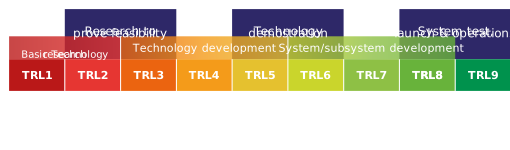
Technological Maturity 5-6
Strengths
- Cost
- Social/economic relevance
- Legal/regulatory content
- Efficiency/productivity/performance
- Innovation
- Lack of technology/solution for the specific task
- Scalability
- Ease of use
- Transferability/mobility
Admissible applications
- Resistance or aging tests of materials to ultraviolet radiation, even extraterrestrial
- Surface treatments for sterilization or sanitization
- Treatment of plant organisms (plants and fruits) to kill viruses, fungi and bacteria and to increase their resistance to pathogen attacks
Research group involved
Revision date
06-05-2026
Didn't find what you were looking for or would like more information ?