
Collection of ENEA technology and expertise

Torularhodin extraction method based on the use of CO2
The patent provides for an extraction with supercritical CO2 in two successive phases; in the first, using pure CO2, all the carotenoids present in the red yeast matrix are extracted with the exception of Torularodin, in the second one the residual matrix is subjected to a further extraction with CO2 added with ethanol allowing the recovery of Torularodin.

Application sectors
Problem to solve
The extraction and separation techniques of natural carotenoids from different matrices generally involve the use of potentially harmful and highly flammable organic solvents with the production of waste that is difficult to manage. The proposed technology allows obtaining an extract free of solvent residues, avoids the use of chromatographic separation techniques, does not damage thermolabile molecules, is easily transferable on a large scale and minimizes the production of waste, resulting in an eco-friendly process. To obtain natural carotenoids the patent provides for the use of red yeasts as a biological resource, which unlike plants do not have limits due to seasonality. Furthermore, from a circular bioeconomy perspective, red yeasts can be grown on culture media derived from agro-food waste.
Description
For the production of Torularodin, generally, red yeasts are grown inside bioreactors on synthetic liquid substrates or using agro-industrial waste and subsequently the yeast cells are lysed and subjected to the extraction method with CO2 in supercritical conditions, the subject of the patent. The extraction process of Torularodin from biomass is characterized by two phases. In the first phase, the dry biomass of lysed cells of microorganisms is subjected to the extractive action of CO2 as the only solvent, obtaining an extract rich in apolar carotenoids without traces of residual solvents. In the second phase, the residual biomass, obtained from the first extraction phase, is subjected to the extraction action of CO2 together with a polar co-solvent, allowing to obtain an extract in which Torularodin represents approximately 95% of the total carotenoids.
Innovative aspects and advantages
- Avoids solvent residues in extracts and the use of chromatographic separation techniques
- Does not involve the use of toxic solvents
- Environmentally friendly and safe procedure
- Preserves the biological properties of extracts
- Simple and easily scalable process
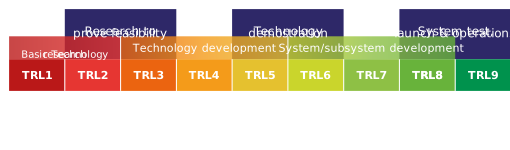
Technological Maturity 4
Strengths
- Cost
- Social/economic relevance
- Legal/regulatory content
Admissible applications
- Cosmetic
- Food: development and formulation of new additives
- Nutraceutical
- Pharmaceutical
Research group involved
Patent Available for Licensing
Disponibile per una licenza esclusiva
Revision date
04-06-2025
Didn't find what you were looking for or would like more information ?