
Collection of ENEA technology and expertise

Technologies and spectroscopic characterizations for solid state materials before and after gamma irradiation
The spectroscopic characterization technology by coupling FTIR, micro-Raman, EPR, PL, UV-vis spectroscopies enables advanced analysis of the chemical and physical properties of both natural and synthetic materials through the integration of various spectroscopic techniques. The laboratory allows for the monitoring of structural and compositional changes, including those resulting from gamma irradiation processes. It is applicable in strategic sectors such as aerospace, energy, agri-food, packaging, electronics, and cultural heritage, supporting innovation and sustainability.

Application sectors
Problem to solve
The increasing complexity of advanced materials and the need to develop sustainable, high-performance solutions for strategic sectors such as aerospace, agri-food, energy, and diagnostics require a deep understanding of the chemical and physical properties of materials. However, the lack of integrated and versatile tools often limits the ability to comprehensively analyze innovative materials—both natural and synthetic—and to monitor their changes during processes such as gamma irradiation. The spectroscopic characterization laboratory addresses this need by offering advanced techniques to study, optimize, and control complex materials, thus promoting innovation, safety, and sustainability in industrial and scientific applications.
Description
The proposed solution consists of a laboratory that uses advanced spectroscopic techniques, such as FTIR, micro-Raman, EPR, PL, UV-vis spectroscopies, to integratively analyze the composition and properties of materials. This approach enables the rapid and precise identification of changes in materials during industrial or research processes, such as gamma irradiation, which can be performed at the Calliope Facility where the characterization laboratory is located. The innovation addresses the need to understand and control materials more efficiently and sustainably, with direct applications in the energy, aerospace, agri-food, diagnostics, and cultural heritage preservation sectors.
Innovative aspects and advantages
- Applicability to a wide range of materials, both natural and synthetic, ensuring high flexibility of use.
- Driving innovation in strategic sectors through more accurate data for research, diagnostics, cultural heritage conservation, and industrial development.
- Integrated and simultaneous analysis of the chemical and physical properties of materials, reducing time and costs compared to separate techniques.
- Real-time monitoring of the effects of treatments such as gamma irradiation on complex materials.
- Support of sustainability of industrial processes by enabling optimization of materials and treatments during development.
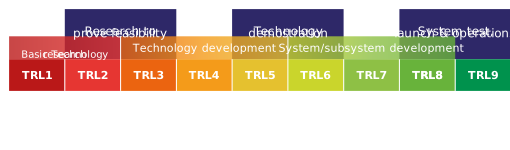
Technological Maturity 5
Strengths
- Cost
- Social/economic relevance
- Legal/regulatory content
Admissible applications
- Biopolymers and materials for agro-food and packaging applications
- Materials based on synthetic or natural origin polymers activated, sinthesized or modified by means of gamma irradiation
- Materials for Cultural Heritage preservation
- Materials for aerospace applications
- Materials for energy, industry, optoelectronic, flexible electronics and smart fabrication applications
Research group involved
Patent Available for Licensing
Non disponibile per una licenza
Revision date
04-06-2025
Didn't find what you were looking for or would like more information ?