
Collection of ENEA technology and expertise
Sustainability Meets Art: Biocleaning for the Preservation of Cultural Heritage
The technology, protected by an ENEA patent, involves a bio-cleaning procedure for coherent deposits of various types—even layered—on different types of artworks, using micro-packs containing viable bacterial cells. The bacteria used are spontaneous environmental strains, preserved in the EMCC collection. The procedure is selective, without damaging the artwork surfaces and/or the noble patina; it can be applied to numerous cases and tailored, in line with modern principles of sustainable restoration

Painting on canvas, Tarquinio Grassi, 1730. Biocleaning
Application sectors
Problem to solve
Procedure that uses, either alone or in combination, specific non-pathogenic bacteria, immobilized in an easily applicable and removable gel, for the selective cleaning of deposits, even overlapping, without damaging the paint or the constitutive material of artifacts and without leaving residues. The procedure is harmless and selective and is intended to replace toxic and aggressive products
Description
In accordance with the new principles of sustainable restoration, the technology involves a bio-cleaning procedure for coherent deposits of various types—even layered—on different types of artworks, using micropacks containing viable bacterial cells. The bacteria used are specifically selected, aerobic, non-pathogenic, spontaneous environmental strains, available from the EMCC microbial collection. The supporting gel, prepared at appropriate concentrations, immobilizes the bacterial cells while maintaining the right humidity. It allows the micropack to be easily applied even to vertical surfaces or ceilings, and at the end of the treatment, it is easily removable without leaving residue. The procedure is selective, does not damage the artwork's surface or its noble patina; it can be applied to numerous cases and it is "tailor-made" adaptable
Innovative aspects and advantages
- Compatibility with the constituent material
- No toxic effects for operators
- Safety for the work of art
- selective action allows for targeted intervention
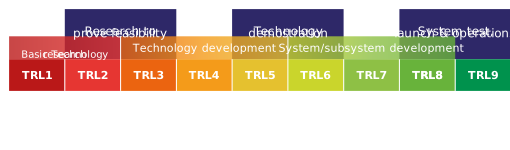
Technological Maturity 7-8
Strengths
- Cost
- Social/economic relevance
- Legal/regulatory content
- Efficiency/productivity/performance
- Innovation
Admissible applications
- Biocleaning
- Biodeteriogen control
Research group involved
Patent Available for Licensing
Disponibile per una licenza non esclusiva
Revision date
13-11-2025
Didn't find what you were looking for or would like more information ?