
Collection of ENEA technology and expertise

Smart Spectroscopic sensors in agrifood and Internet of Things (IoT)- METROFOOD -IT
The spectroscopic sensors developed at ENEA Frascati are sensors operating in the visible (400-700 nm) and infrared (400-4000 cm-1) spectrums. Using the change in the vibrational state of molecules as a result of the excitation of light, the sensors can determine in real time the fingerprints of the chemical compounds present in a food sample.The spectral differences characteristic of each product allow a rapid screening of its quality. The sensors can be applied to both liquid and solid matrices.
Application sectors
Problem to solve
Food quality and safety is an issue of increasing concern to the public and manufacturers. Smart spectroscopical sensors, even portable ones, are able to determine the biochemical profile of food and any deliberate or accidental contamination. Spectroscopy in the visible and infrared spectrum detects the molecular 'fingerprint' of the product to determine its quality, origin and possible safety fraud, so that individual products can be removed or recalled using biological methods. re
Description
The most commonly used techniques to assess the quality and possible contamination of agri-food products are destructive and random sampling. However, these methods require time-consuming extraction and analysis, which does not allow on-line analysis, as well as specialised personnel. Given the cost of analysis, random sampling is the method of choice. Therefore, an accurate and reliable instrument is needed that can measure in real time on a large number of more representative samples. Spectroscopic sensors developed at ENEA in Frascati can meet this requirement. They detect, in real time and in a non-destructive way, the distinctive chemical compounds of each product analysed, by means of their "molecular fingerprints", which can be used to compare samples. The spectral differences specific to each product allow rapid screening of the quality of each product. The sensors can be applied to both liquid and solid matrices.
Innovative aspects and advantages
- Easy to use
- No or negligble sample handling
- Non-invasive
- Real time detection
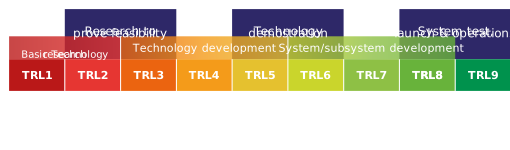
Technological Maturity 2-3
Strengths
- Cost
- Social/economic relevance
- Legal/regulatory content
- Efficiency/productivity/performance
- Innovation
Admissible applications
- Non-destructive diagnostics for quality and safety in the food chain
- Remote connection of sensors, Internet of Things, with other partner for food safety and quality
- Smart sensors for assessing the origin of food products
- Spectroscopic diagnostics for food fraud detection
Research group involved
Revision date
03-06-2025
Didn't find what you were looking for or would like more information ?