
Collection of ENEA technology and expertise
Raman spectroscopy for characterization of materials and radiation detectors
Non-invasive material diagnostic based on Raman spectroscopy with surface and volume scanning. Raman spectroscopy is a non-invasive, non-destructive diagnostic method that uses a laser beam to read the chemical structure of the material under examination. A laser beam is focused on the sample, and the output is the Raman spectrum, which is effectively a digital fingerprint of the substance. The system is coupled with a confocal microscope, allowing for spatially resolved diagnostics, resulting in 2D/3D chemical maps of the studied sample.

Application sectors
Problem to solve
The industry often needs non-destructive diagnostics for process control and the quality of the material produced (mechanical properties, resistance to radiation and hostile environments, detection efficiency). Raman spectroscopy gives detailed information about the structure/polymorphism/phases/crystallinity of the sample under examination using simply laser radiation. By focusing the laser using a microscope, it is possible to analyze the sample locally and study spatial variations in composition and structure. By means of automatic scanning, measurements can be repeated in different areas of the sample. It is a fast contact-less and non-destructive analysis and it is not necessary to prepare the sample before measurement.
Description
The diagnostic protocols for spectral imaging provided a 2D/3D structural mapping of the analyzed material that can be superimposed on the corresponding optical microscope image. The parameters that allow the structural visualization, which goes beyond the morphology of the optical image, derive only from the spectral characteristics of the Raman trace (intensity, position and width of the peak,...). It can be applied for the analysis of: solid, liquid, gel, organic/inorganic/biological materials, composites, polymer (also multilayers) and film.
Innovative aspects and advantages
- 2D and 3D chemical maps
- It is not required any sample preparation
- Multiscale technique
- Non - invasive diagnostic of materials with high level of chemical species discrimination
- Quick data collection and interpretation
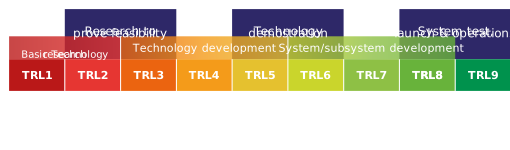
Technological Maturity 7
Strengths
- Cost
- Social/economic relevance
- Legal/regulatory content
- Efficiency/productivity/performance
- Innovation
- Lack of technology/solution for the specific task
- Scalability
- Ease of use
- Transferability/mobility
- Processing/feed-back times
- Non-invasiveness
- No necessity for additional facilities
Admissible applications
- Diagnostica avanzata di materiali: struttura, stress/strain, mappatura chimico composizionale 2D/3D
- Diagnostica efficacia e non invasività trattamenti di pulizia e disinfestazione carte antiche e pergamene.
- Diagnostica non invasiva per i beni culturali, in particolare la carta antica.
Research group involved
Patent Available for Licensing
Non disponibile per una licenza
Revision date
27-05-2025
Didn't find what you were looking for or would like more information ?