
Collection of ENEA technology and expertise

Quantum Spectrometer
Quantum Ghost Spectroscopy (QGS) is a sophisticated method to reveal spectral features of atarget without analyzing the light that passed through it. It is based on the use of frequency quantum correlations of pairs of photons generated via Spontaneous Parametric Down Conversion (SPDC). Due to the correlations intrinsic to the pair-production process, the analysis of one of the correlated photons provides information on what has occurred to its twin. These photons could belong also to different wavelength range, i.e. the first in the visible and the second in the infrared range.

Application sectors
Problem to solve
In the field of sensing, there is a need to perform measurements based on low-radiation flux. In this framework, the quantum approach allows to extract the greatest amount of information using a low amount of resources, i.e. photons. The infrared region has several limitations related to the use of detectors for which noise represents a still significant limiting factor.
Description
Our system is based on a QGS apparatus adapted to non-degenerate SPDC emission. This regime allowed us to associate measurements performed on the visible photon with spectral features proper to the target in the near IR, where absorption peaks occur. Photon pairs have been produced by illuminating a nonlinear crystal (NLC): the idler photon at lower energy (?i ? 1550 nm) went through the sample and then reached the bucket detector, a SPAD. The signal photon (?s ? 810 nm) has been delivered to a single-grating spectrometer followed by an intensified CCD (iCCD). The spectral acquisition has been triggered by the SPAD and, in order to account for the delay in the bucket detector response, the signal photon has been delayed by means of an optical delay line in a multimode fiber, while fine tuning has been implemented by means of an FPGA. The thickness of the NLC dictates the spectral width of the generated photons, while the correlation mainly depends on the pump shape. The grating in the spectrometer was selected accordingly to have 600 lines/mm or 1200 lines/mm by means of an automated control. The QGS setup has been calibrated by using an interference filter and then employed with both liquid and gaseous samples. For the liquid samples a cuvette was placed instead of the test filter and the same setup has been employed. For gaseous samples, we designed and realized an optical cell equipped with a suitable vacuum system composed by a membrane pump for the prevacuum and a turbomolecular pump. This cell was integrated in the bucket arm to allow the interaction between the sample and the idler photon. We performed experiments based on the absorbance of the samples, given the intensity of the collected radiation that can be described by a simple Lambert-Beer equation: I = I0 * Exp[-µ(?) ?l] where I (I0) is the intensity with (without) the sample, µ(?) is the absorption coefficient and ?l is the length of the absorbing material.
Innovative aspects and advantages
- Exploiting spectral correlations between two photons hardly accessible spectral regions can be explored
- Correlations could be exploited to perform remote sensing measurements.
- Quantum light has widened the range of applications harnessing quantum frequency correlations
- classical counteparts show worse performances
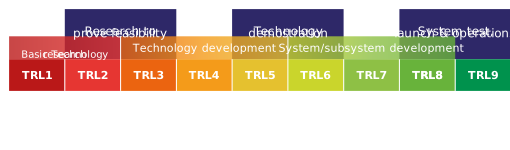
Technological Maturity 3-4
Strengths
- Cost
- Social/economic relevance
- Legal/regulatory content
Admissible applications
- Detection of harmful target, e.g. CBRN threats
- Near Infrared Spectroscopy
- Quantum Sensing
- Study of frgaile compouds
Research group involved
Patent Available for Licensing
Non disponibile per una licenza
Revision date
03-06-2025
Didn't find what you were looking for or would like more information ?