
Collection of ENEA technology and expertise

Process for the treatment of Olive Mill Wastewater via reforming
The process developed consists of an innovative treatment of the Olive Mill Wastewater. The process produces a gaseous mixture mainly consisting of hydrogen and methane: during laboratory tests about 18 m3 of hydrogen have been produced from 1 ton of OMW. After filtration and concentration, the OMW are processed in a chemical reactor via reforming to produce a gaseous fuel stream.

Olive mill wastewater process scheme
Application sectors
Problem to solve
The worldwide annual production of around 5 milion of tons of olive and about 2.5 milion of tons of olive oil, while it produces about 10-30 milion m3 of Olive Mill Wastewater (OMW). The OMW has high organic matter content and, therefore, the release of this un-treated waste impacts seriously the environment. Because of its organic acid content, the OMW pH is very acid. In Italy the land disposal of OMW is the most common practice while only its minor amounts are treated in depuration plants. Further, the land disposal represents a not-negligible cost item for the small-medium enterprises of the olive oil sector.
Description
The process developed consists of an innovative treatment of the Olive Mill Wastewater. The process produces a gaseous mixture mainly consisting of hydrogen and methane: during laboratory tests about 18 m3 of hydrogen have been produced from 1 ton of OMW. After filtration and concentration, the OMW are processed in a chemical reactor via reforming to produce a gaseous fuel stream. Further, by using a membrane reactor, ultra-pure hydrogen is produced and high reaction conversions are achieved. The energy needed to sustain the reforming process represents an important share of the operation costs and, alternatively, can be provided by the combustion of the pomace and the syngas produced, and by exploiting the heat recovered by the process units.
Innovative aspects and advantages
- Production of gaseous fuels
- Reduced operation costs and possibility of heat recovery from the combustion of biomass
- Reduction of the pollution content of the Olive Mill Wastewater
- Use of mature and low-cost components and technologies
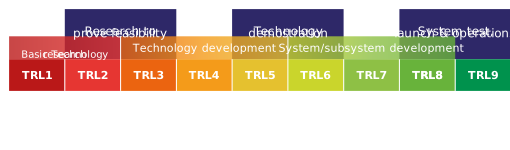
Technological Maturity 3-4
Strengths
- Cost
- Social/economic relevance
- Legal/regulatory content
Admissible applications
- Olive Mil Wastewater treatment aimed at reducing its pollution content
- Syngas production from Olive Mill Wastewater
Research group involved
Patent Available for Licensing
Disponibile per una licenza non esclusiva
Revision date
03-02-2026
Didn't find what you were looking for or would like more information ?