
Collection of ENEA technology and expertise

Polymeric microgels for biotechnology and sensing applications
Microgels are soft colloidal particles composed of polymer networks, combining the properties of colloids and polymers. Due to their ability to modify physicochemical properties in response to environmental stimuli (such as temperature, pH, and ionic strength), microgels are considered smart materials of great interest for the development of optical and photonic devices, sensors, and bio-interfaces. They have applications in drug delivery, tissue engineering, thermoresponsive cell culture surfaces, and the integration into technological devices.

Application sectors
Problem to solve
To study the effects of ionizing radiation on living organisms, it is necessary to interface radiation detectors with biological systems in order to correlate the radiation dose absorbed by the cells with cellular damage. Moreover, the development of biocompatible high spatial resolution detectors for cell cultures is one of the main challenges in studying the sub-micrometric structures of biological tissues using X-ray imaging with laboratory-scale sources. In cultural heritage conservation, the main issues are related to the cleaning and treatment of artworks and ancient artifacts, with non-invasive, effective, and sustainable protocols. In the field of sensing, microgels offer advanced solutions for the detection of analytes at low concentrations, real-time monitoring without destructive processes, miniaturization and integration into microfluidic devices, flexible electronics, and optical biosensors.
Description
Microgels are crosslinked polymeric particles, ranging in nanometric to micrometric sizes, that combine the typical properties of gels and colloids. Due to their crosslinked and hydrophilic structure, they can absorb large amounts of water or solvents, swelling or shrinking in response to environmental stimuli such as temperature, pH, ionic strength, or magnetic fields. This characteristic makes them soft, flexible, and highly hydrated materials, whose behaviour is governed by the interaction between polymer chains and the solvent. By combining the versatility of polymers with the responsiveness of colloids, microgels represent an innovative frontier in materials science, paving the way for advanced solutions in various technological applications. They can be tailored to respond to specific stimuli, making them ideal as smart sensors capable of detecting and signaling the presence of target substances in the environment, monitoring physiological parameters, or identifying biomolecules such as glucose or pathogens. Additionally, they can be combined with fluorescent dyes or other optical indicators to develop sensors that detect fluorescence variations or colorimetric responses based on environmental conditions. Thermoresponsive microgels can be used to create "smart" cell culture substrates that regulate cell adhesion and detachment through temperature changes. Furthermore, microgel films offer novel solutions for interfacing technological devices with biological systems. In particular, the integration of microgel films with lithium fluoride-based radiation detectors allows cells to be deposited directly onto the detector's surface, enabling the development of biocompatible devices for radiobiology experiments and contact X-ray microscopy on cells and biological tissues.
Innovative aspects and advantages
- Biocompatibility and Environmental Sustainability
- High Sensitivity and Specificity
- High Versatility and Ease of Functionalization
- Integration with Technological Devices
- Response to Environmental Stimuli
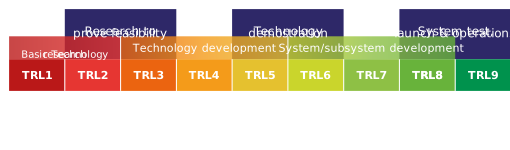
Technological Maturity 2-3
Strengths
- Cost
- Social/economic relevance
- Legal/regulatory content
Admissible applications
- Biocompatible coatings for radiation detectors for radiobiology and cellular imaging
- Sensors and biosensors based on microgel response to external stimuli
- Smart substrates for cell cultures
Research group involved
Patent Available for Licensing
Disponibile per una licenza non esclusiva
Revision date
30-05-2025
Didn't find what you were looking for or would like more information ?