
Collection of ENEA technology and expertise

Plant Virus Nanoparticles
Viruses are ideal protein cages for nanotechnology applications. They have characteristics suitable for nanoscale applications, are homogeneous, biodegradable, with a high surface/volume ratio and a defined, repetitive and symmetric macromolecular organization. Plant viruses, in particular, are produced in plants, a practical and economical system, with limited initial capital investment and low management costs, and with great potential in terms of scalability, sustainability, production speed and intrinsic biosafety.

Schematic representation of large-scale production of plant virus nanoparticles and their possible applications
Application sectors
Problem to solve
In nanomaterial science, the nanoparticle production system represents a particularly important aspect. Plant viruses are designed to self-assemble according to a bottom-up approach, and they replicate quickly and efficiently in the production system, the host plant, which they will infect completely autonomously. This allows to significantly reduce costs and shorten production and purification times. Plant viruses also constitute a biocompatible material with a very high intrinsic biosafety. Plant viruses are very diverse in shape and size, representing a huge source of particles to draw from, depending on the desired application.
Description
ENEA possesses the (non-exclusive) know-how for the production of plant viral nanoparticles in confined environments, their purification and their engineering. Wer have also used some viruses in various projects for the production of new vaccine formulations, diagnostic systems, catalytic supports, and drug delivery systems, acquiring specific expertise in these application fields and obtaining numerous information about the potential of these nanoparticles (immunological response, therapeutic efficacy, toxicity, biodistribution, stability). The plant "biofactory" also represents a production system with very high yields, obtained in a short time, and at low costs.
Innovative aspects and advantages
- Ease of genetic/chemical modification and possibility to modify the external surface and/or internal cavity
- Self-assembly - Nanoscale dimensions - High surface area to volume ratio
- cost-effectiveness, speed, sustainability, scalability, biosafety
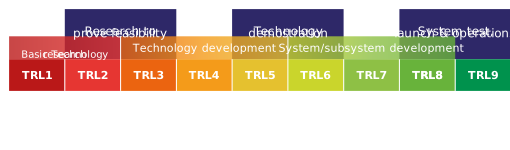
Technological Maturity 3-4
Strengths
- Cost
- Social/economic relevance
- Legal/regulatory content
- Efficiency/productivity/performance
- Innovation
- Lack of technology/solution for the specific task
- Scalability
- Ease of use
Admissible applications
- catalytic support
- diagnostic devices
- drug targeting and delivery
- subunit vaccines formulations
Research group involved
Patent Available for Licensing
Disponibile per una licenza esclusiva
Revision date
27-06-2025
Didn't find what you were looking for or would like more information ?