
Collection of ENEA technology and expertise

A photoacoustic laser spectroscopy for quality and safety control of food samples
Laser photoacoustic spectroscopy (LPAS) is based on the interaction between modulated electromagnetic radiation and an absorbing material. When a substance absorbs light at a certain wavelength, the absorbed energy causes local heating, generating a periodic expansion that produces pressure waves (sound) that can be detected by a microphone or transducer. The technique is used for the analysis of gases, liquids and solids with high sensitivity and selectivity, allowing the detection of concentrations in the parts per billion (ppb) or even parts per trillion (ppt) range.
Application sectors
Problem to solve
Although the invention can be used with all phases of matter in the most varied application fields, it was developed for the quality and safety control of solid food samples, a sector in which fraud is increasingly occurring.
Description
a prototype for a production line and a prototype for fast analyses were developed. The latter is contained in a suitcase, is battery operated and ready to be evaluated by end-users. Currently, analyses are carried out with laboratory instruments that require qualified personnel and long times. Such devices are likely to remain unmatched in terms of sensitivity and specificity, especially when particularly low detection limits are required, but the photoacoustic laser system could be complementary, providing a quick indication that a supply is suspect.
Innovative aspects and advantages
- It can analyze solids, liquids and gases without preparation, improving versatility.
- LPAS is not affected by light scattering, making it ideal for analysis in complex matrices.
- Sensitivity: Gas concentrations down to parts per trillion (ppt) can be detected, exceeding the sensitivity of techniques such as UV-Vis absorption spectroscopy or FTIR.
- The use of quantum cascade lasers (QCLs) allows for high spectral resolution, improving selectivity in identifying specific chemical species compared to traditional IR spectroscopy.
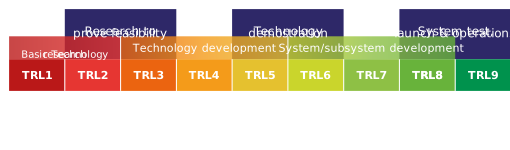
Technological Maturity 4-5
Strengths
- Cost
- Social/economic relevance
- Legal/regulatory content
- Efficiency/productivity/performance
- Innovation
- Lack of technology/solution for the specific task
- Scalability
Admissible applications
- Detection of explosives, hazardous chemicals and biological agents thanks to the ability to identify minute traces of substances.
- Environmental monitoring of polluting gases and volatile organic compounds (VOCs) with high sensitivity.
- Study of molecular properties and chemical reaction dynamics with high spectral resolution
Research group involved
Patent Available for Licensing
Disponibile per una licenza non esclusiva
Revision date
04-06-2025
Didn't find what you were looking for or would like more information ?