
Collection of ENEA technology and expertise

Passive ionising radiation detectors based on lithium fluoride thin films for dosimetry and imaging
Passive lithium fluoride (LiF) thin-film detectors, which can detect all types of ionizing radiations, are based on optical reading of photoluminescence emitted by radiation-induced electronic defects. They are characterized by high spatial resolution, large field of view, wide dynamic range and ease of use. The photoluminescence response is linear as a function of irradiation dose up to about 10^5 Gy and it is stable over time. The ionizing radiation response of lithium fluoride is also equivalent to that of human tissue.

Application sectors
Problem to solve
In the field of ionising radiations (X-rays, gamma rays, protons, electrons, neutrons, heavy charged particles) detecting, for applications ranging from biomedical to materials science and aerospace, it is essential to use low cost detectors with high performance in terms of spatial resolution, dynamic range, field of view and non-destructive readout (i.e. repeatable without signal loss). Radiation detectors based on lithium fluoride thin films meet these requirements, and in addition offer high versatility because it is possible tailoring their geometry and sizes according to the experiment to be carried out, as they are deposited by thermal evaporation on different substrates (glass, silicon, aluminium, flexible plastic layers, etc.) in ENEA laboratories.
Description
Lithium fluoride (LiF) thin-film detectors can detect all types of ionizing radiations (X-rays, gamma rays, protons, neutrons, electrons, heavy charged particles, etc.). They are passive detectors, based on the optical readout of photoluminescence emitted by radiation-induced electronic defects, known as color centers. LiF film-based detectors are grown by thermal evaporation, under controlled conditions, on different substrates (glass, silicon, aluminum, flexible plastic substrates, etc.) and they offer high versatility because it is possible tailoring their geometry and sizes according to the experiment to be carried out. They are low cost detectors with performance in terms of spatial resolution, field of view, dynamic range, and ease of use, which make them extremely interesting and promising for applications ranging from nuclear to biomedical sector.
Innovative aspects and advantages
- The optical readout process of LiF film-based detectors (Vis spectral range) is efficient and fast (seconds)
- Their photoluminescence response is stable over time and it is linear as a function of irradiation dose up to about 10^5 Gy
- They are characterized by high spatial resolution (< 250 nm), wide dynamic range ( > 10^5), large field of view ( > 1 cm^2) and they are tissue-equivalent
- They are easy handling (insensitive to light, no development needs)
- They are low cost and multi-purpose (X and gamma rays, protons, neutrons, electrons, etc.)
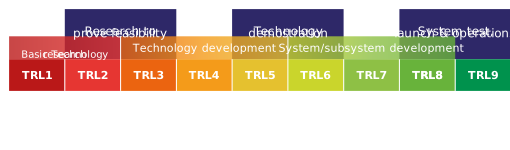
Technological Maturity 4
Strengths
- Cost
- Social/economic relevance
- Legal/regulatory content
Admissible applications
- Advanced diagnostics of ionising radiation sources
- Dosimetry in fission and fusion energy and aerospace
- Ionising radiation exposure monitoring in the bio-medical field
- Radiobiology
- X-ray imaging of biological samples
Research group involved
Revision date
30-05-2025
Didn't find what you were looking for or would like more information ?