
Collection of ENEA technology and expertise

Optical reading radiation detectors for dosimetry in radiotherapy, radiobiology and cosmic radiation
Radiation detectors based on crystals or pellets of LiF powder to characterize proton, X-ray and gamma ray beams used in radiotherapy and to obtain the absorbed dose after irradiation, by reading of the visible photoluminescence signal emitted by the defects created in the LiF by the radiations, which can be acquired with a spectrometer or a fluorescence microscope. The signal intensity has a linear dependence with the dose up to 100 kGy, is independent of the dose rate and also allows obtaining images of tracks left in the detector by single ions at doses lower than 1 Gy.

Application sectors
Problem to solve
In radiotherapy treatments it is essential to know the spatial and dosimetric characteristics of the radiation beam in the widest possible dose range, using different types of radiation, in order to effectively damage tumor cells and minimize damage to healthy cells. In long-term space missions it is paramount to know both the kind and the amount of ionizing radiations to which both astronauts and electronic equipments are exposed.
Description
Radiation detectors based on crystals or pellets of pressed lithium fluoride (LiF) powder, which allow to obtain the image of the proton, X-ray and gamma ray beams used in radiotherapy and to obtain the absorbed dose after irradiation, by reading of the visible photoluminescence signal emitted by the defects created in the LiF by the radiations, which can be acquired with a spectrometer or a conventional or confocal fluorescence microscope. The signal intensity has a linear dependence with the dose up to 100 kGy, is independent of the dose rate and allows also obtaining the image of the tracks left in the detector by single ions at doses lower than 1 Gy in radiobiology and space weather. A protoype of optical reader is available, specifically realized for the dosimeter.
Innovative aspects and advantages
- Interaction with ionizing radiation equivalent to that of the human body.
- Linear response of the photoluminescence signal as a function of the dose up to 100 kGy and dynamic range of 114 dB (19 bit)
- Possibility of radiation beam imaging in 2D and 3D
- Reusable after annealing and no chemical development needed for signal reading
- The photoluminescence signal is stable in time, independent from the dose-rate and, for proton beams, from the linear energy transfer (LET) in the range typically used in protontherapy
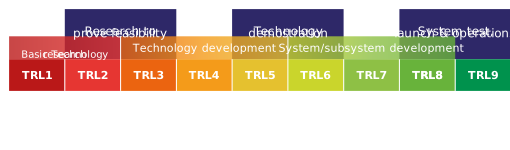
Technological Maturity 3-4
Strengths
- Cost
- Social/economic relevance
- Legal/regulatory content
Admissible applications
- Clinical dosimetry in radiotherapy
- Detector of ion tracks in nuclear reactions
- Detector of ionizing radiations in space
- Dosimetry for radiobiology
- Dosimetry up to doses of the order of 100 kGy
Research group involved
Revision date
30-05-2025
Didn't find what you were looking for or would like more information ?