
Collection of ENEA technology and expertise

NasusDS: a device for the assessment of the personal exposure to the air pollutants
The technology featuring NasusDS joins the advantages of the low-cost miniaturized gas sensors and the smartphone technology. The device leverages the sensor good sensitivity and their low power consumption. It is composed of two eleectronic boards designed for converting sensor output signals into data concerning the concentrations of NO2, O3, CO, and SO2 gases. These data are transmitted to a smartphnone via bluetooth to form a file acting as database in which, thanks to the GPS usually embedded in any smartphone, it is written the datum related to the date, time and the georeferentiation.

Application sectors
Problem to solve
Air quality monitoring is performed by on-purpose agencies through instrumentation based on extremely reliable technologies, but featured by high costs, both as concerning their purchase, and their maintenance and management. Moreover, such strumentation is not portable and needs a suitable sistemation for its operation. These factors limit the deployment of a suitable number of monitoring stations to cover a territory, making impossible the actual assessment of the personal exposure to air pollutants and the linked risks. An option for these technologies is represented by the electrochemical gas sensors on which the operation of the device here proposed is based. Even though characterized by a lower accuracy, they offer some advantages, such as: low costs, high miniaturization grade and no maintenance.
Description
NasusDS device is composed of two electronic boards based on an original design which leverages the advantages of the miniaturized low-cost electrochemical gas sensors with the advaantages offered by the smartphone technology. The weak electronic currents composing the output signals of the sensors are adequately amplified and the electronic noise affecting them is conveniently reduced. Subsequently, they are converted into data concerning the gas concentrations through the microprocessor featuring this device. The electronics used for the implementation of NasusDS is based on parts characterized by a very low power consumption. This feature makes feasible the powering of the device through a litium rechargeable battery. The sensor output readings are converted into a digital format and then transmitted via bluetooth to a smartphone device where a suitable "App" stores them in a file acting as database. This database is composed of records formed by the gas concentration measures together the date and time and the geographic coordinates of the measurement. The georeferentiation of each record is possible thanks to the GPS device normally embedded in any type of smartphone model.
Innovative aspects and advantages
- capability to easily set up air quality monitoring networks
- capability to perform mobile air quality monitoring
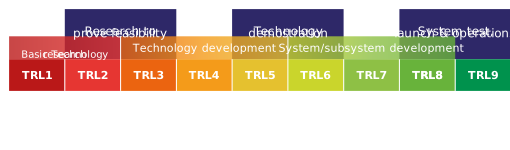
Technological Maturity 9
Strengths
- Cost
- Social/economic relevance
- Legal/regulatory content
- Efficiency/productivity/performance
- Innovation
- Lack of technology/solution for the specific task
- Scalability
- Ease of use
- Transferability/mobility
- Processing/feed-back times
Admissible applications
- air quality monitoring in vehicles and means of transportation cabins
- indoor air quality monitoring
- indoor air quality monitoring networks
- mobile monitoring of the air quality
- monitoring of the personal exposure to the air pollutants
Research group involved
Patent Available for Licensing
Disponibile per una licenza esclusiva
Revision date
20-06-2025
Didn't find what you were looking for or would like more information ?