
Collection of ENEA technology and expertise

Nano Digital Twins to predict the health impact of biological molecules, drugs, and airborne pollutants.
This technology integrates various molecular modeling and simulation methods into a single computational pipeline, enabling a detailed view of molecular interactions. By creating digital twins of bioactive molecules and their targets, it allows precise simulations to predict their effectiveness and safety without costly experiments. Useful in drug development, nutraceutical research, and environmental studies, it accelerates innovation while reducing risks and costs

Example of a digital twin of a molecular complex consisting of an epigenetic enzyme (green) and a natural bioactive molecule (red
Application sectors
Problem to solve
The development of drugs and natural therapeutic molecules requires lengthy and costly preclinical trials. In silico experimentation, based on molecular simulations, is limited by high computational demands, often beyond the reach of SMEs. Predicting the effects of airborne pollutants on cellular health is also challenging, as traditional methods fail to accurately replicate molecular impacts. The nano digital twin, supported by ENEA's molecular dynamics simulations and HPC computing, can address these challenges. This technology enables the visualization of interactions between molecules and therapeutic targets, accelerating the testing of drugs and natural molecules while precisely predicting the effects of pollutants on cellular health.
Description
The innovation of this technology lies in the integration of various molecular modeling and simulation approaches into a single computational pipeline, which enables the unification and optimization of both traditional and advanced techniques to provide a comprehensive and detailed view of molecular interactions, significantly reducing the time and resources needed to analyze complex scenarios. The technology creates digital models, known as digital twins, of bioactive molecules and their biological targets, such as enzymes or receptors. These models allow for precise simulations of how molecules interact with each other, offering a detailed understanding of their properties and predicting their effectiveness and safety without the need for costly experiments. The simulations can also be adapted to different scenarios to test how molecules react to environmental changes, such as temperature or pH. This technology is useful in fields such as drug development, nutraceutical research, and the study of the effects of pollutants on the environment and human health. It helps develop safer, more targeted solutions, accelerating innovation while reducing the risks and costs associated with traditional methods.
Innovative aspects and advantages
- Advanced Data Management
- Advanced visualization of Molecular Processes
- High-Performance Computing (HPC)
- Reduced Costs and Reduction in Animal Testing
- Speed
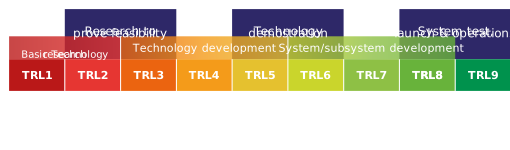
Technological Maturity 4
Strengths
- Cost
- Social/economic relevance
- Legal/regulatory content
- Efficiency/productivity/performance
- Innovation
- Lack of technology/solution for the specific task
- Scalability
Admissible applications
- Prediction and enhancement of the functional properties of food
- Optimized design of therapeutic biomolecules and prediction of their efficacy
- Prediction of adverse effects of environmental pollutant molecules
Research group involved
Patent Available for Licensing
Non disponibile per una licenza
Revision date
30-06-2025
Didn't find what you were looking for or would like more information ?