
Collection of ENEA technology and expertise

Multifunctional structure made with beached biomasses
A multipurpose structure made with beached biomasses; said multipurpose structure being characterised in that it comprises a casing made with a cloth of biocompatible fibres and a stuffing made with biomasses collected from the beaches.

Application sectors
Problem to solve
Seagrass wrack accumulates during the winter along about 60% of the Italian and Mediterranean Sea shorelines. Their removal, through mixing, can generate a large amount of waste. The separation of waste allows for the re-use of beached plant biomass in the marine-coastal environment. The ENEA patent makes it possible to use these biomasses as a filling material for multipurpose pillows that can be submerged in the sea. This is an intervention that reproduces natural processes and uses plant biomasses as a fertile substrate to encourage the replanting of seagrasses in the damaged sea grass meadow (by trawling, anchoring, pollution).
Description
A multipurpose structure made with beached biomasses; said multipurpose structure being characterised in that it comprises a casing made with a cloth of biocompatible fibres and a stuffing made with biomasses collected from the beaches. A multipurpose structure, characterised in that said cloth has meshes with viariable dimensions, and said biocompatible fibres have a resistance to longitudinal pull that is higher than or equal to 9kN/m as well as a resistance to transverse pull that is higher than or equal to 20kN/m. A multipurpose structure characterised in that said biocompatible fibres are comprised in the group consisting of jute fibres, hemp fibres, coconut fibres, Neptune Grass fibres and-or other marine or terrestrial plants, whose marketing is or will be allowed. A multipurpose structure according to any of the previous claims, characterised in that said biomasses collected from the beaches consist of fibres, rhizomes, leaves of maritime plants and-or seaweeds, small organisms, and sediments. A seabed covering by means of one or more multipurpose structures so as to obtain a more regular and almost level morphological restoration. A covering for non-vegetated seabed by means of one or more multipurpose structures so as to create a substrate in which to encourage or operate a vegetation reimplantation in a marine-coastal and lagoonal environment.
Innovative aspects and advantages
- Economic: reforestation of the seagrass meadow can be used for compensation of environmental impacts, create new jobs, and contribute to the development of new markets in the carbon credit sector.
- Economic: reforestation of the seagrass-seabed can be used for compensation of environmental impacts, contribute to the increase of job opportunities and the development of new markets in the carbon credit sector.
- Social: "sea immersion" allows vegetal biomass to be removed from the shores, creating social benefits in terms of employment and the development of new professional skills, involving public-private stakeholders and NGO.
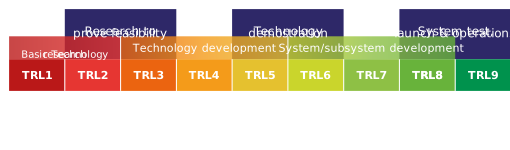
Technological Maturity 7-8
Strengths
- Cost
- Social/economic relevance
- Legal/regulatory content
- Efficiency/productivity/performance
- Innovation
- Lack of technology/solution for the specific task
- Scalability
- Ease of use
- Transferability/mobility
- Processing/feed-back times
- Non-invasiveness
Admissible applications
- ECONOMIC: territorial development, fisheries, tourism, carbon credits
- ENVIRONMENTAL: conservation of natural resources and habitat protection
- SOCIAL: information and training of stakeholders (public and private)
Research group involved
Patent Available for Licensing
Disponibile per una licenza non esclusiva
Revision date
26-06-2025
Didn't find what you were looking for or would like more information ?