
Collection of ENEA technology and expertise

Microbial technologies for the bioremediation of polluted matrices
Bioremediation is an advanced strategy to remove or immobilize heavy metals, radionuclides, and degrade complex pollutants such as hydrocarbons, PCBs, pesticides, and PFAS. It is ideal for contaminated soils, groundwater, and exposed waters where traditional methods are costly and invasive. Assisted phytoremediation, combining plants and microorganisms, is among the most promising solutions. This technology reduces costs and environmental impact, promoting sustainability and resource recovery in line with the bioeconomy.

Growth and hydrocarbons-degradation on solid and liquid media with oil
Application sectors
Problem to solve
Soils, waters, and sediments contaminated by heavy metals, persistent organic compounds, and industrial residues represent not only a risk to ecosystems but also a loss of valuable resources. Traditional remediation techniques, based on chemical-physical interventions, are often invasive, costly, and generate large amounts of waste, further contributing to soil and water consumption. Bioremediation makes it possible to recover these resources and restore them to optimal functional conditions, reducing environmental impact and promoting sustainability. A strategic aspect is the possibility of recovering critical raw materials from mining waste, red mud, and waste electrical and electronic equipment (WEEE), transforming what is currently considered a problem into a resource for the circular economy. In this way, an innovative approach is promoted that combines remediation, material valorization, and ecosystem protection.
Description
Bioremediation is emerging as an advanced strategy for tackling environmental contamination, thanks to its ability to remove heavy metals, radionuclides, and degrade complex organic pollutants such as petroleum hydrocarbons (TPH), polycyclic aromatic hydrocarbons (PAHs), polychlorinated biphenyls (PCBs), and pesticides. This approach is particularly suitable for interventions on large areas, in the presence of contaminated soils or shallow groundwater, and for the remediation of exposed water bodies, where traditional techniques often prove costly and invasive. A promising aspect is the possibility of combining two complementary strategies: phytoremediation, which exploits the ability of plants to absorb and stabilize contaminants, and bioaugmentation with plant growth-promoting bacteria, giving rise to the so-called assisted phytoremediation. This synergy is particularly effective in degraded contexts characterized by multiple criticalities, such as soil sterility, the presence of different types of pollutants, the large extent of affected areas, and the need to properly manage plant biomass, which may be rich in contaminants. Thanks to these solutions, bioremediation not only reduces environmental impact and remediation costs but also promotes a sustainable and circular approach, in line with the principles of the bioeconomy. It is a technology that combines effectiveness, respect for ecosystems, and innovation, opening new perspectives for managing environmental emergencies.
Innovative aspects and advantages
- circularity
- sustainability
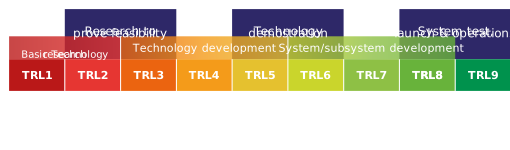
Technological Maturity 7
Strengths
- Cost
- Social/economic relevance
- Legal/regulatory content
- Efficiency/productivity/performance
- Innovation
Admissible applications
- Biorestoration
- polluted soil
- recovery of raw materials
Research group involved
Revision date
20-05-2026
Didn't find what you were looking for or would like more information ?