
Collection of ENEA technology and expertise

Metal Additive Manufacturing - Electron Beam Melting (EBM)
Electron Beam Melting is a 3D metal printing process that uses electrons as a source for the localized melting of metal particles. This powder bed technology allows the creation of components with complex geometries starting from a CAD model. Through appropriate design, it is in fact possible to create lightweight components in which, in the less stressed parts, the material has been removed, using lattice or trabecular structures. EBM finds application in various application sectors.

Application sectors
Problem to solve
3D printing of metals using the EBM process allows to: i) create components with complex geometries; ii) create lightweight components with trabecular or lattice structures; iii) create components in materials that are difficult to work with traditional processes (Titanium Alloy, Ti6Al4V); iv) drastically reduce the number of pieces that make up the final component; v) use a limited number of supports requiring less mechanical processing, compared to other powder bed metal printing processes.
Description
3D printing using Electron Beam Melting (EBM) technology allows you to create printed parts from metal or metal alloy powders. The printer has a chamber in which the metal particles melt and solidify rapidly. The chamber works in a vacuum and the print bed is heated to approximately 700°C during the process. An electron beam is produced inside the electron gun where there is a tungsten filament that is heated by the passage of a current. The beam is accelerated in an electro-optical column that allows focusing on the print bed and deflection to allow localized fusion of the particles.
Innovative aspects and advantages
- EBM can print high-performance materials, such as titanium, nickel, cobalt-chromium and other alloys, which are difficult to process with conventional methods.
- High printing speed compared to other powder bed 3D printing processes
- It is possible to recover and reuse process powders for subsequent prints, reducing material waste to a minimum.
- Possibility to print different components in a single job
- The process takes place in vacuum allowing for less contamination of the process dust
- Microstructural characterization of advanced materials in bulk or powder form
- Observations and investigations of different types of samples, both organic and inorganic
- Sample preparation for optical and electronic microscopy: grinding and polishing, sputtering and evaporation of conductive films, metallographic etching
- The present equipment allows, by integrating the different data obtainable, to provide a complete characterization of the samples
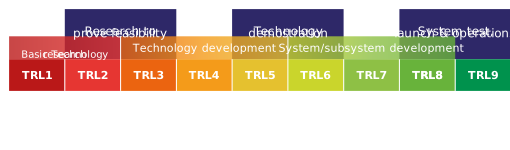
Technological Maturity 5
Strengths
- Cost
- Social/economic relevance
- Legal/regulatory content
Admissible applications
- Construction of turbines for the energy production sector
- Production of components for the aerospace sector
- Production of prostheses for the biomedical sector, lightweight structural components for the aerospace and transport sectors, turbines for energy production
- Production of prostheses thanks to the biocompatibility of the Ti6Al4V titanium alloy
Research group involved
Revision date
25-06-2025
Didn't find what you were looking for or would like more information ?