
Collection of ENEA technology and expertise

Membrane Gas-Liquid Contactor for the extraction of hydrogen from liquid metals
The innovative process and the device developed are dedicated to the extraction of the hydrogen isotopes from liquid metals. In particular, the device has been designed for the recovery of tritium from the liquid breeding blankets of the nuclear fusion reactors, mainly consisting of Li-alloys. The same membrane device can work as a sensor for detecting the concentration of hydrogen and its isotopes into liquid metals.

Application sectors
Problem to solve
Effective and reliable tritium extraction from the breeding blanket is a technological requirement needed for the realization of nuclear fusion reactors: in fact, efficient tritium extraction systems allow the reduction of both the tritium inventory (i.e. the amount of tritium uploaded into the breeding blanket that could be released in case of accident) and the time needed to achieve the steady-state operating conditions of the fusion fuel cycle (i.e. the condition in which the tritium produced in the blanket is extracted and purified before to be sent into the plasma chamber to sustain the fusion reactions). Accordingly, the safe and stable operation of a fusion plant can be guaranteed only by an efficient tritium extraction system.
Description
The device has been developed for extracting tritium and the other hydrogen isotopes from the breeding blankets of the fusion reactors made of eutectic LiPb alloy. Such a device works by realizing a direct interface between the liquid LiPb and the gas phase extracting the hydrogen isotopes. Under proper design and operation conditions, the liquids (in this case the melted LiPb) wet the porous membranes without passing through them. In such a way, inside the membrane pores there is the direct contact the liquid LiPb and the gas phase then reducing significantly the hydrogen mass transport resistance and increasing both the efficiency and the speed of the extraction processes.
Innovative aspects and advantages
- Higher efficiency for extracting hydrogen and its isotopes from liquid metals
- Realization of rapid-response and highly sensitive sensors for detecting the hydrogen concentration into liquid metals
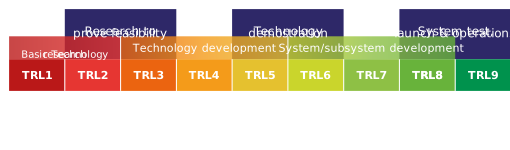
Technological Maturity 2-3
Strengths
- Cost
- Social/economic relevance
- Legal/regulatory content
- Efficiency/productivity/performance
- Innovation
- Lack of technology/solution for the specific task
Admissible applications
- Construction of sensors for the measurement of hydrogen and its isotopes into liquid metals
- Extraction and measurement of the tritium concentration in the liquid metal used in the IV generation nuclear fission reactors cooled by Sodium or Lead
- Extraction of hydrogen isotopes (hydrogen, deuterium and tritium) from the breeding blankets of the fusion nuclear reactors
Research group involved
Patent Available for Licensing
Disponibile per una licenza non esclusiva
Revision date
26-05-2025
Didn't find what you were looking for or would like more information ?