
Collection of ENEA technology and expertise

Mechanical treatment of silicon-based powder obtained from photovoltaic panels to obtain lithium-ion battery anodes with high specific capacity
The invention relates to a process for the production of lithium battery (LiBs) anodes from end-of-life or defective photovoltaic (PV) panels, which are shredded after the removal of the frame, cables, and junction box. The fragments containing silicon are then separated from the polymer component (EVA) and glass and subjected to thermal treatment. The resulting powder undergoes a series of sieving and grinding steps until a fraction of material suitable for use in the anode of LIBs is obtained.

Application sectors
Problem to solve
The installed photovoltaic power in the world is growing and, since the lifetime of a photovoltaic panel is about 25-30 years, about 60-78 million tons of photovoltaic panels are expected to be disposed of in 2050. Dismantled panels are a resource of useful and valuable materials. Some of them, such as silicon, are classified by the European Union as strategic materials, i.e. materials of high importance for strategic areas but at risk of supply. It is therefore extremely useful to recover silicon from photovoltaic panels at the end of their life in order to be able to re-introduce it into different supply chains such as that of lithium-ion batteries. It is important that recovery technologies have the minimum environmental impact to offer a sustainable way of sourcing this precious material.
Description
The process addresses the fabrication of lithium ion battery (LIBs) anodes from end-of-life or defective photovoltaic panels (PVs). The panels are shredded after removing the frame, the cables and the junction box. Fragments containing silicon are separated from polymeric (EVA) and glass fractions and finally thermally treated. The obtained powder is repeatedly sieved and ground until a material suitable to be used as anode material in LiBs is obtained without any chemical treatment and purification. Nanometric carbon and a polymeric binder are added to the recovered silicon powder. The slurry is deposited and dried on a copper sheet to obtain the LIBs anode. The search for new anode materials as an alternative to the graphite currently used in commercial lithium ion batteries is driven not only by the fact that graphite is a strategic materialfor Europe, but also (and perhaps more so) by the continuous demand for batteries with ever higher energy density and, therefore, by the growing demand for anodes with higher specific capacity than graphite. In particular, silicon offers a theoretical specific capacity of 4200 mAh g-1, which is considerably higher than the theoretical specific capacity of graphite (372 mAh g-1). The innovative process developed, which consists of a suitably studied sequence of grinding and sieving steps, aims to eliminate oxidized components with low electrical conductivity, as well as metallic components with lithiation capability lower than silicon. Meanwhile, the silicon powder is progressively reduced to sub-micrometric dimension in order to obtain, in the electrode construction phase, a high specific surface and a low volumetric expansion of the anode material during operation in the cell. The silicon powder recovered by the process protected by the invention is capable of forming alloys with lithium and can therefore potentially be used as an anode material as a substitute for graphite.
Innovative aspects and advantages
- LIBs with energy density higher with respect to commercial ones
- Reduction of graphite content in LIBs
- Reuse of silicon recovered from end-of-life or defective PVs without chemical purification
- Use of CMC, instead of PVDF, as polymeric ligand with economical, environmental and sustainability advantages
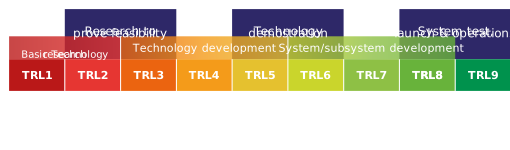
Technological Maturity 4
Strengths
- Cost
- Social/economic relevance
- Legal/regulatory content
- Efficiency/productivity/performance
- Innovation
- Lack of technology/solution for the specific task
- Scalability
- Ease of use
Admissible applications
- Lithium Ion Batteries
- Recycle of defective or dismissed silicon-based photovoltic panels
Research group involved
Patent Available for Licensing
Disponibile per una licenza esclusiva
Revision date
06-02-2025
Didn't find what you were looking for or would like more information ?