
Collection of ENEA technology and expertise

Magnetic catalyst for the electrification of production processes
Catalytic processes powered by electromagnetic induction, or more briefly “magnetic catalysis”, uses materials capable of catalyzing the chemical process of interest and, at the same time, capable of dissipating the energy of an alternating magnetic field into process heat. For the implementation of magnetic catalysis in high temperature thermochemical processes (T>700°C), catalysts consisting of nanoparticles of Nickel-Cobalt alloy supported on gamma-Al2O3 have been developed. Magnetic catalysis can be extended to endothermic and exothermic processes.

Application sectors
Problem to solve
The invention relates to a class of supported catalysts, and related synthesis process, in which the active element is a magnetic material, preferably in the form of a nanoparticle, capable of simultaneously catalyzing a chemical process and providing the heat necessary for the chemical reaction by dissipating energy when immersed in an alternating magnetic field. The idea developed aims to reduce the energy consumption associated with catalytic processes by using r. f. electromagnetic induction technology to provide process heat at high temperature.
Description
The patent describes the synthesis of supported catalysts whose active element is a magnetic material in the form of nano particles (eg Ni, Co and their alloys) suitably distributed on the support. The nanoparticles are at the same time able to catalyze the process and provide the heat necessary to feed the reaction. The materials conceived and developed by ENEA are able, in a magnetic field generated with a commercial induction oven, to reach 800°C allowing to considerably expand the use of magnetic catalysis, so far limited to isolated examples of medium-low temperature (<450 ° C) reactions, to endothermic industrial processes such as reforming reactions.
Innovative aspects and advantages
- Selective heating of the catalyst; Instant heating: possibility of feeding discontinuous processes efficiently without expensive heat recovery systems; Shutdown of production processes in short times with advantages on plant safety; Increased selecti
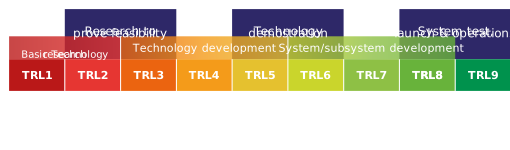
Technological Maturity 3-4
Strengths
- Cost
- Social/economic relevance
- Legal/regulatory content
Admissible applications
- possible coupling of chemical flow reactors to intermittent energy sources
- Electrification of chemical processes
- Hetaing rate >300°C/min
Research group involved
Patent Available for Licensing
Disponibile per una licenza esclusiva
Revision date
12-05-2025
Didn't find what you were looking for or would like more information ?