
Collection of ENEA technology and expertise

Laser and chemical synthesis and characterization of nanomaterials
Synthesis of inorganic oxide and semiconductor nanoparticles using laser pyrolysis, functionalization of nanoparticles and production of polymer nanocomposites, tailored for the specific application

Application sectors
Problem to solve
Ceramic nanoparticles synthesis by wet chemical process often has some drawbacks such as low productivity, low dimensional and shape control and presence of impurities. In addition, wet chemical processes have major environmental implications as the reagents used and the by-products generated are often harmful for the environment and operators. An alternative synthesis method that does not use solvents or catalysts and allows good control of the characteristics of nanoparticles could improve the time and cost of nanomaterial production.
Description
Laser pyrolysis is used for the synthesis of nanoparticles such as Silicon, Silicon Carbide, Carbon, Silica, Titanium Dioxide. A chemical reaction is induced by gas-phase or aerosol-phase reactants and thanks to the energy provided by the laser, which takes place at high temperatures and the desired nanoparticles are formed. By varying the process parameters, it is possible to change the size, aggregation and chemical composition of the products, and it is possible to obtain doped particles in situ. Productivity is high and the nanomaterials obtained are of high purity and contamination-free. The absence of solvents and unwanted products makes the method eco-friendly
Innovative aspects and advantages
- eco-friendly synthesis method because it does not involve use of solvents and there are no polluting by-products
- high productivity
- nanoparticles are pure, with tailored chemical characteristics and dimensions
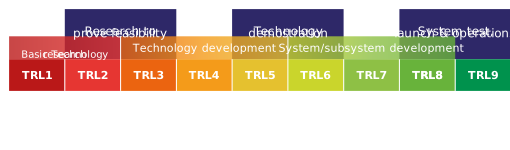
Technological Maturity 5-6
Strengths
- Cost
- Social/economic relevance
- Legal/regulatory content
- Efficiency/productivity/performance
- Innovation
- Lack of technology/solution for the specific task
- Scalability
- Ease of use
- Transferability/mobility
Admissible applications
- as sensors, in particular in bioimaging or biosensors
- in batteries and photovoltaic cells, TiO2 nanoparticles as active elements in anodes and cathodes
- in cultural heritage, polymer nanocomposites used as protective layers and for integrative restoration, containing nanoparticles of SiO2, TiO2, SiC
- in photonics, Si and C nanoparticles as luminescent active elements in liquid dispersions or polymer nanocomposites
Research group involved
Patent Available for Licensing
Non disponibile per una licenza
Revision date
03-06-2025
Didn't find what you were looking for or would like more information ?