
Collection of ENEA technology and expertise

Integrated solution of eco-sustainable autonomous sensors for environmental monitoring in buildings
The developed technology enables the recovery and storage of normally wasted thermal and light energy, powering autonomous sensors for environmental monitoring. Components such as supercapacitors and sensors, made with eco-friendly materials derived from natural or waste resources, reduce environmental impact. The integration of emerging indoor photovoltaic technologies (e.g., DSSC/PSC) and low-power, high-efficiency thermoelectric generators enhances energy efficiency, comfort, and system resilience across multiple strategic sectors

Diagram of the main components of the integrated solution for energy harvesting and environmental monitoring with eco-friendly components
Application sectors
Problem to solve
Many strategic sectors face the challenge of managing energy and resources sustainably while maintaining efficient system monitoring and control. In the contexts of energy and buildings, thermal and light energy flows are often lost without recovery, whereas sensors and electronic devices require a continuous and reliable power supply. The prevalent use of conventional materials limits the sustainability of electronic systems and contributes to increased electronic waste, with associated environmental impacts. Therefore, there is a need to develop innovative and integrated solutions based on eco-friendly materials and emerging technologies, capable of harvesting and storing energy for autonomous devices, supporting environmental monitoring networks, enhancing energy efficiency, indoor comfort, and system resilience, while fostering the circular economy and advancing the transition toward sustainable technologies
Description
The proposed technology integrates energy harvesting and storage systems with autonomous environmental monitoring devices, relying on eco-friendly materials and emerging technologies. The system captures thermal and light energy flows present in buildings, typically dissipated, converting them into electrical energy through emerging photovoltaic cells and low-gradient thermoelectric generators. The supercapacitors and selected sensors are fabricated using natural or waste-derived materials, significantly reducing the environmental impact of electronic devices and promoting a circular-economy approach. These elements enable stable storage of the harvested energy and continuous sensor operation even under fluctuating lighting conditions or thermal gradients. The energy platform combines indoor photovoltaic cells based on dye-sensitized solar cell (DSSC) and perovskite solar cell (PSC) technologies, low-gradient thermoelectric generators, ultra-low-power electronics, and advanced energy-management systems. Together, these components capture energy from intermittent sources and optimally distribute it to the sensing modules. This innovation enables the design of distributed sensor networks within buildings, improving overall energy efficiency, occupant comfort, and system resilience. The use of sustainable materials and low-impact fabrication processes contributes to reducing electronic waste and supports the development of autonomous devices aligned with ecological transition goals
Innovative aspects and advantages
- Combines DSSC/PSC photovoltaic cells and thermoelectric generators, delivering superior performance even under low-light conditions compared to conventional technologies
- Provides autonomous power to indoor sensors by harvesting thermal and light energy normally lost, reducing costs and dependence on external power sources
- Reduces reliance on traditional batteries, promoting a sustainable and circular approach with economic and environmental advantages over existing solutions
- Supports the deployment of distributed sensor networks in buildings, enhancing monitoring capabilities and system efficiency
- Uses eco-friendly materials derived from natural or waste sources, minimizing environmental impact compared to conventional components
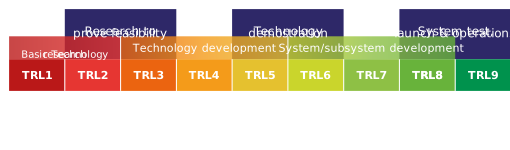
Technological Maturity 5-6
Strengths
- Cost
- Social/economic relevance
- Legal/regulatory content
- Efficiency/productivity/performance
Admissible applications
- Indoor monitoring of temperature, humidity, and air quality using autonomous, low-power devices
- Integration into smart-building platforms to optimize climate control, ventilation, and indoor environmental quality
- Powering sensor networks for building energy management without the need for wiring or frequent battery replacement
- Recovery and utilization of thermal and light energy in buildings to power sensors and monitoring systems
- Support for energy-efficiency and indoor comfort solutions through self-powered data-collection systems
Research group involved
Patent Available for Licensing
Non disponibile per una licenza
Revision date
20-11-2025
Didn't find what you were looking for or would like more information ?