
Collection of ENEA technology and expertise

Instrument for spectroscopic analysis ILS (Integrated Laser Sensor)
ILS is a unique instrument, patented by ENEA, that performs measurements at distance (8-30 m) with following multiple techniques: LIF (Laser Induced Fluorescence), Laser Scattering (LS), Raman e LIBS (Laser Induced Breakdown Spectroscopy). In combination, these techniques supply information about state of surface, changes from one zone to another, molecular composition and element content. The instrument is easy to use thanks to GUI user-friendly.

Exalples of results of detection by using ILS
Application sectors
Problem to solve
A single spectroscopic technique can supply limited information about surface state and chemical composition. Integration of various techniques into a single instrument, like LIF, Raman and LIBS in the ILS, brings great advantages, particularly in case of rapid and simple switching among the measurement techniques. Measurements at distance could be necessary for safety reasons or because of difficult access to the object. In such cases, the ILS supplies a full solution, including a remote control via WiFi of the instrument. The detection sensitivity strongly depends on the initials projecting of the instrument. In case of ILS, thanks to careful choice of components and ENEA's patented solution, a single high power laser source is used for generating IR laser beam (for LIBS) or UV beam (for LIF and Raman), thus reducing the costs, dimensions and weight, and achieving a very high detection sensitivity
Description
ILS is the only instrument (patented by ENEA) that performs measurements at distance (8-30 m) with multiple techniques: LIF, Laser Scattering (LS), Raman and LIBS. The combination of these techniques supplies information about the state of surface, the molecular and elemental composition. Thanks to a color camera and GUI, the user can explore the scene, select an area to scan and the point density. Fast scanning by LIF/LS (<1 s per point) can identify classes of materials and areas of interest. Raman measurements (~ 10 s per point) can identify molecular composition. LIBS (<1 s per point) detects the elements present on the surface. By applying more laser pulses at a fixed point, also the element distribution in depth is achieved, with spatial resolution in order of 100 nm - 10 µm, dependent on the material. Differently from LIF, LS and Raman, LIBS technique is micro-destructive inside the focal spot; at distance of 10 m, the laser spot has minimum diameter of 1.2 mm. The instrument contains a class IV laser source, it is mounted on a towable cart, and during outdoor campaigns its was used autonomously powered by two generators. The control could be done through remote desktop, thanks to the built-in WiFi. Switching among the measurement techniques is done via GUI, where the positioning of the optical components according to the selected technique and target distance is automatic. For each measurement, the spectra are saved automatically including the timestamp and the relative position on the scanning grid. Presently, the ILS database supports the automatic recognition of explosives and precursors while for the LIBS technique the element identification is implemented. On a 2D map in false colors, overlapped with live image of the target, it is possible to visualize all results of the measurements, as default or selected by user.
Innovative aspects and advantages
- Measurements at distance (8-30 m) and in scanning, by using different techniques and with an almost immediate switch among the techniques, without further intervention of an operator
- The automatic material recognition is presently implemented only for explosives and precursors. The database could be extended to recognize also other types of materials
- The external color camera, together with the motors and GUI, allow exploring the scene, selecting the area to scan, localizing the points of interest, and generating 2D thematic maps overlapped by the target's image
- The instrument allows to characterize the surface state, identify molecular and elemental composition with sensitivy in order of 100 ng and 1 ng, respectively
- The instrument is transportable, easy to use, powered by 220 VAC o generators, and it is controllable remotely (via own WiFi)
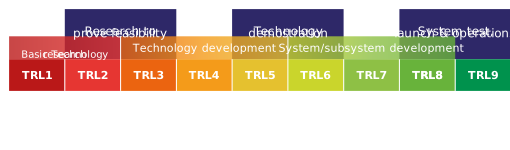
Technological Maturity 5-6
Strengths
- Cost
- Social/economic relevance
- Legal/regulatory content
- Efficiency/productivity/performance
- Innovation
- Lack of technology/solution for the specific task
- Scalability
- Ease of use
- Transferability/mobility
Admissible applications
- Adaptation of the instrument for a specific application and real-time monitoring for industry, environment, security etc
- Detection and identification of trace materials (in order 1-100 ng) on surfaces
- Identification of areas with different surface and chemical characteristics.
- Measurements of element distributions in the first few millimeters of solid materials
- Molecular and elemental analysis during surface scanning at distances 8-30 m (tested)
Research group involved
Patent Available for Licensing
Disponibile per una licenza non esclusiva
Revision date
28-11-2025
Didn't find what you were looking for or would like more information ?