
Collection of ENEA technology and expertise

Innovative Mo-99 production methodology via 14 MeV fusion neutrons
Use of neutrons produced by deuterium-tritium nuclear fusion to produce medical radioisotopes for both therapeutic and diagnostic use.
Application sectors
Problem to solve
The obsolescence of fission reactors dedicated to the production of Mo-99 and the need to overcome the use of uranium-235 for its production prompted international organizations such as WHO and OECD to push scientists in proposing valid alternatives for the production of this radioisotope. In official OECD and NEA documents, fusion neutrons are recognized as a possible alternative, but the lack of an intense source of neutrons effectively prevents their use for industrial purposes. The development of intense fusion neutron sources would help complement the production of Mo-99 from reactors in the medium term, presenting a valid alternative in the long term, with lower costs and less environmental impact.
Description
The proposed solution involves the use of a beam of accelerated deuterium and tritium ions. The ions implant in a rotating metal target and make nuclear fusion reactions to occur. The power of the plant (250 kW) allows to obtain a fusion neutron production rate of 5-7E13 neutrons per second, at least 1000 times more intense than the accelerator-driven neutron generators currently operating. The high brightness allows for the irradiation of important quantities of metallic molybdenum (natural or enriched in Mo-100 depending on the needs), obtaining Mo-99 activities capable of satisfying the needs of a large Italian region and with low environmental impact.
Innovative aspects and advantages
- compact
- modularity
- sustainability
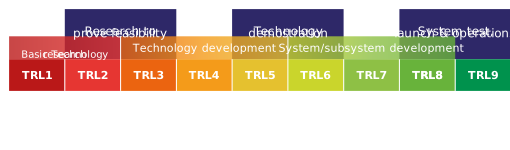
Technological Maturity 4-5
Strengths
- Cost
- Social/economic relevance
- Legal/regulatory content
- Efficiency/productivity/performance
- Innovation
- Lack of technology/solution for the specific task
- Scalability
- Ease of use
- Transferability/mobility
- Processing/feed-back times
Admissible applications
- Production of medical radioisotopes
- fast and slow neutron beams for materials science
- neutron beams for aerospace and automotive studies
- neutron beams for fusion technology
Research group involved
Patent Available for Licensing
Disponibile per una licenza esclusiva
Revision date
05-02-2025
Didn't find what you were looking for or would like more information ?