
Collection of ENEA technology and expertise

High accuracy electronic solar compass
High resolution electronic compass (down to 1/100 of a degree) based on the detection of the sun position by a CCD sensor. It is not affected by the Earth's magnetic field and related perturbations
Application sectors
Problem to solve
Identifying the direction of geographic North with high precision (<< 1°) is of crucial importance in all the application fields described in point "13" but is difficult to achieve. Magnetic compasses lack precision in the presence of ferromagnetic bodies nearby and due to the fact that the magnetic pole moves continuously. The problem becomes dramatic at high latitudes or on planets like Mars where the magnetic field is missing. Gyroscopic compasses are accurate but slow and expensive and drop in accuracy at high latitudes (>70°). The same applies to systems based on differential GPS, to which vulnerability to solar storms adds.
Description
The Compass exploits visible solar radiation but the possibility of exploiting microwave radiation for operation with cloudy skies is also being tested as part of an ENEA PoC project. It uses ENEA-owned mathematical algorithms to obtain the orientation of the Sun and therefore the direction of North with respect to the compass. It does not necessarily require having an internet or GPS signal. Furthermore, with appropriate modifications, it can work on other planets too. It is therefore of great interest for space missions to allow rovers to return to base after journeys of kilometers without ever losing orientation, for the search for life forms in space biology.
Innovative aspects and advantages
- Thanks to the use of only sun postion, this compass works perfectly also at extreme latitudes (e.g. Antarctica) where the other compasses type fail for various reasons.
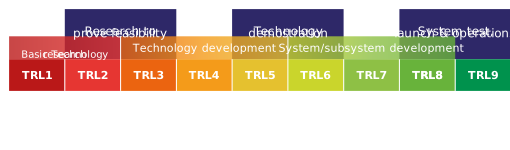
Technological Maturity 7-8
Strengths
- Cost
- Social/economic relevance
- Legal/regulatory content
- Efficiency/productivity/performance
- Innovation
- Lack of technology/solution for the specific task
- Scalability
- Ease of use
- Transferability/mobility
- Processing/feed-back times
- Non-invasiveness
Admissible applications
- accurate calibration of magnetic compass for marine navigation
- accurate measurements of magnetic declination at critical sites (e.g. Antarctica)
- control and management of critical environmental places
- orientation and management of solar systems for energy production
- orientation of mobile systems in areas not served by satellite systems and calculation of position with sextant function even on other planets
Research group involved
Patent Available for Licensing
Disponibile per una licenza non esclusiva
Revision date
26-05-2025
Didn't find what you were looking for or would like more information ?