
Collection of ENEA technology and expertise

Elemental analysis of materials by LIBS (Laser Induced Breakdown Spectroscopy)
LIBS technique is based on a local plasma generation by a laser pulse and spectrally resolved detection of the plasma emission from solid, liquid or gaseous sample. The result of the analysis is a content of major, minor and trace elements in the sample part involved in the plasma formation. The technique is micro-destructive inside the laser spot with diameter in order of 0.1 mm. On solid samples, by applying a sequence of the laser pulses it is possible to obtain element distributions in depth up to ~1 mm, with space resolution in order from 100 nm to 10 µm, depending on the material type.

Application sectors
Problem to solve
Full elemental composition of samples can be determined, for example, by ICP coupled to OES or MS, but these techniques require laborious and destructive sample preparation. Differently, Laser-Ablation (LA) in combination with the previous techniques provides highly sensitive elemental analysis with minimal sample preparation and invasiveness, but such instruments have high purchase and maintenance costs and can be used only for laboratory measurements. Differently, the instruments based on XRF might be portable and cost effective, they do not require sample preparation, and the measurements are relatively rapid. However, XRF tools have following disadvantages compared to the LIBS: a) Unable to measure light elements; b) Much higher limit of detection; c) Difficulty to measure trace samples; d) Much lower in-depth resolution; e) impossibility to measure at distances
Description
ENEA developed various LIBS instruments LIBS (table-top, stand-off, compact hand-held, mounted on a robotic arm), for different applications. The last developed instrument works both in hand-held mode and static mode. It contains a high magnification colour camera for visualizing the sample with or without illumination by a white LED. The static structure mounts X-Y-Z micrometric slits for precise positioning and surface scanning. In a handheld mode, the focal plane is determined by interception of two red pointing beams. The sample image before the laser pulse(s) is automatically acquired while the sample location on a large scene is supported by the image acquisition via Android phone and the dedicated app. The GUI (Graphical User Interface) controls the instrument and monitors its status. The operator places inputs: location, case ID, sample name, annotation, measuring parameters, eventual element to be excluded from the concentration measurements (e.g. Si for traces on Si wafer); these inputs are automatically saved and, together with the acquired data, they are associated with a timestamp. The instrument is controlled via laptop, although predisposed for being operated via LCD on the sensor head. The measurement is rapid (~1 s) and the results (spectra, signal quality, relative composition, detection probability, eventual substance identification) are displayed almost immediately. Presently, an algorithm for recognition of explosives and gunshot residues are implemented while the recognition of other types of materials could be also developed. The detailed results and element distribution in sample depth might be displayed. The full data relative to the measurement can be sent to API. The instrument is compact, the component weights are: Laser head 3.3 kg, instrument box <3.5 kg, Tabletop structure 4.4 kg. The powering is by 220V or by the own battery pack. The instrument contains class IV laser source.
Innovative aspects and advantages
- Built-in colour camera and external photography via Android and dedicated app provides details about the sample aspect and its eventual position on a wide scene. These data, the instrument status, parameters and results are automatically saved.
- Capability to perform surface scanning with lateral resolution of about 0.3 mm and analyse element distribution in depth of solids for the first ~1 mm with resolution of 0.1-10 µm, depending on material hardness.
- Compact portable instrument, easy to use, working in a hand-held mode or static mode – on lightweight structure with micrometric slits. Powering is via 220 VAC or battery pack inside the instrument box (backpack).
- Rapid measurements (~1s) of elemental composition, including light elements, without or with minimal sample preparation (solid or liquid sample). It works also with trace sample quantities, with mass in order of 1 ng.
- The automatic material recognition is presently implemented for explosives and gunshot residues but could be provided for other material classes. The measurement data could be sent to API
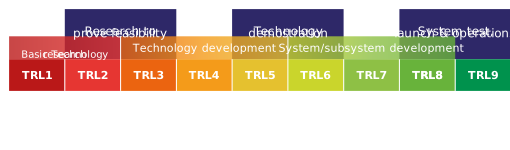
Technological Maturity 5-6
Strengths
- Cost
- Social/economic relevance
- Legal/regulatory content
- Efficiency/productivity/performance
- Innovation
- Lack of technology/solution for the specific task
- Scalability
- Ease of use
- Transferability/mobility
- Processing/feed-back times
Admissible applications
- Adaptation of the instrument for a specific application and measurements in real-time, as for example, industrial or environmental monitoring, measurements from distance of a few meters, and else.
- Analysis of stratigraphic distribution of elements inside a solid sample.
- Elemental analysis of trace solid or liquid materials on original surfaces or transferred on a reference substrate (e.g. silica wafer).
- Mapping of surface distribution of elements on solid materials.
- Rapid analysis of elemental composition, includin light elements, in solid or liquid samples.
Research group involved
Revision date
03-06-2025
Didn't find what you were looking for or would like more information ?