
Collection of ENEA technology and expertise
DSlogger: a software tool for collecting data provided by instruments and sensors
The purpose of the DSlogger software is to read measurements from instruments and sensors connected to a PC through commonly available data interfaces (USB and Ethernet) and to store them in a single text file that serves as a database. Readings are performed synchronously on all connected devices and become database records together with their timestamp. The software has a modular structure, meaning it consists of a main core and a set of modules or “drivers” specific to each type of instrument or device

Some instruments and sensors monitored by DSlogger software to carry out measurements in the laboratory
Application sectors
Problem to solve
During laboratory activities, or in environments where multiple measuring instruments and sensors operate simultaneously, there may be a need to collect measurements of different quantities or parameters into a single file, or database, structured in records, each containing measurements from the different devices, but taken synchronously. Accomplishing this task, requires the connection of the involved devices to a computer that, at regular time intervals, reads the various device outputs and stores them in a file. For this purpose, it is necessary to interface hardware with different connection types (USB, Ethernet, GPIO) and communication protocols. The situation becomes even more complex if outdated or obsolete equipment not supporting the SCPI protocol is used. In such cases, the use of this software can solve the problem
Description
The purpose of the DSlogger software is to read measurements from instruments and sensors connected to a PC through the typical data interfaces available on it (USB and Ethernet) and to store them in a single text file that serves as a database. Readings are performed synchronously on all connected devices and become database records together with their timestamp. The software has a modular structure, meaning it consists of a main core and a set of modules or “drivers” specific to each type of instrument or device. The code is written in Python and is therefore completely open-source. This solution avoids use issues related to license or royalty payments. In this first version, the user interface is command-line based. To ensure maximum ease of use, the implemented commands are limited to eight, summarizing all the functionalities provided by the software. At present, drivers have been written for 11 different devices, including sensors and instruments, but the software has been designed to allow the range of manageable devices to be expanded by adding new drivers using the dedicated command, provided they are written by personnel with the appropriate expertise. New drivers must be created following a few compatibility rules contained in a “template” driver. The designed software also allows the connection of devices not supporting the SCPI communication standard, but are equipped with a proprietary data communication protocol, something typically encountered when using older instruments or low-cost sensors
Innovative aspects and advantages
- capability to use old or obsolete hardware
- flexibility and high grade of adjustability
- high scalability
- minimum cost
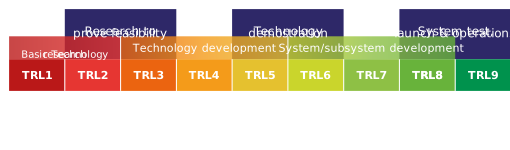
Technological Maturity 9
Strengths
- Cost
- Social/economic relevance
- Legal/regulatory content
- Efficiency/productivity/performance
- Innovation
- Lack of technology/solution for the specific task
- Scalability
- Ease of use
- Transferability/mobility
Admissible applications
- Data collection for air quality monitoring stations
- Database building made of measurements taken with heterogeneous instruments and sensors
- Laboratory experimental activities
Research group involved
Revision date
20-11-2025
Didn't find what you were looking for or would like more information ?