
Collection of ENEA technology and expertise
Characterization of surface materials and pictorial layers, even on large areas, by means of combined spectroscopic techniques as Raman, LIF, LA, LIBS
The NUC-TECFIS-DIM Laboratory is committed to the development of increasingly compact and efficient non-destructive and non-invasive (or micro-destructive) laser systems, based on Laser Induced Fluorescent (LIF), Laser Induced Breakdown spectroscopy (LIBS), Laser Ablation (LA), Raman Spectroscopy, for the characterization of even fragile materials in the laboratory and in situ, even in hostile environments, without the need for sampling or treatment of the target, using only the optical accessory on the surface, and measuring the distance.

Application sectors
Problem to solve
It is often necessary to be able to characterize materials without sampling, in a non-invasive and non-destructive way, in real time or near real time. These needs can be coupled with the need to work at a distance (up to tens of meters) from the targets of interest, on particularly fragile and delicate materials that cannot be touched.
Description
Characterization, evaluations and assessments of the Of fragile materials (forensics, security, CH, environment, ...) nowadays are most of the time combined and supported by scientific study for characterization, diagnostics and monitoring. For such studies, many laboratory methods with high sensitivity are well established (ICP-MS, FTIR,…) for analyses on collected samples. In addition, several punctual or imaging methods for in situ material and surface characterization, like thermovision, UV photography, XRF, colorimetry, are widespread. However, the request for systems that can provide rapid detailed characterization, even on large surface, in any storage conditions is still a hot topic. In fact, in different fields, difficulties due to the simultaneous presence of materials of different natures or multilayered coatings have often to be faced. Besides that, artworks can be in hostile environments or must be examined in dangerous situations which ask for complex interventions. In this context, laser techniques in last decades have been proved to represent very suitable and useful tools. In fact, they don't need sample treatment and require only optical access to the surface under study, allowing for remote measurements. Moreover, they are non-destructive and non-invasive (or micro-destructive), self-illuminating and not affected by external light sources. The NUC-TECFIS-DIM (Diagnostic and Metrology) Laboratory of the ENEA center of Frascati (Rome, Italy) in the last decade has put an effort in developing more and more compact and efficient laser systems, based on Laser Induced Fluorescence (LIF), Laser Induced Breakdown spectroscopy (LIBS), Laser Ablation (LA), Raman Spectroscopy, for laboratory and in situ material characterization coupled to mapping methods based on the individuation of discriminant spectral features.
Innovative aspects and advantages
- Customization
- High performances
- Quasi real time answers
- Stand- off and remote use capability
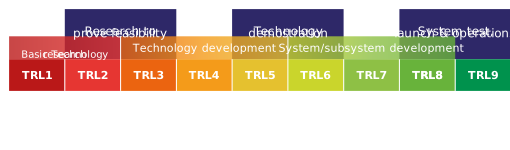
Technological Maturity 7
Strengths
- Cost
- Social/economic relevance
- Legal/regulatory content
Admissible applications
- In cultural heritage, characterization of artistic surfaces for the study of constituent materials, degradation and biological attacks
- In the circular economy field, characterization of materials intended for recycling
- In the environmental field, characterization of the health status of water, soil and plants
- In the forensic field, remote analysis of materials on crime scenes
Research group involved
Patent Available for Licensing
Non disponibile per una licenza
Revision date
26-05-2025
Didn't find what you were looking for or would like more information ?