
Collection of ENEA technology and expertise

CASAS-PBDM Web API workflow to support strategic analysis of olive and olive fly management
The CASAS-PBDM Web API workflow enables using a physiological demographic model (PBDM, see Gutierrez et al. 2009, <https://doi.org/10.1007/s10584-008-9528-4>) of olive and its main pest, the olive fly, and running it on a Web application programming interface (Web API) for the Italian region of Puglia at 250 m spatial resolution and daily time resolution for years 2003 to 2023. Vedi Ponti et al. (2024, <https://doi.org/10.1016/j.cliser.2024.100455>).

Application sectors
Problem to solve
Enhancing the use of climate services for all stakeholders in the agri-food value chain requires that scientists have the capacity to assess the effects of biotic (e.g., crop, pests, and natural enemies) and abiotic (e.g., climate) components of the agroecosystem on sustainable yields. This is a prerequisite for dealing with the increasing complexity of agricultural systems under global change including technological changes, invasive species, and climate change. Mechanistic weather-driven physiologically based demographic models (PBDMs) provide a powerful methodology for assessing the bioeconomic biology of species and their interaction including human economics. This prototype shows how the CASAS-PBDM Web API workflow enables more research users and geographic regions to benefit from the PBDM approach. See publications below.
Description
The CASAS-PBDM Web API workflow enables using a physiological demographic model (PBDM) of olive and its main pest, the olive fly, and running it on a Web application programming interface (Web API) for the Italian region of Puglia at 250 m spatial resolution and daily time resolution for years 2003 to 2023. The model uses daily weather data, including maximum and minimum temperatures derived from MODIS LST satellite data and calibrated with MODIS NDVI, in addition to solar radiation, precipitation, relative humidity, and wind speed from AgERA5 data. MODIS LST temperatures calibrated with NDVI have been shown to estimate olive grove canopy temperature more accurately than interpolation from weather stations. PBDM simulation is then usually mapped using the open source GIS GRASS. Although the model was previously validated in Israel to simulate seasonal olive fly dynamics, PBDM/GIS spatiotemporal patterns should be considered a heuristic rather than a predictive tool. This analysis provides realistic patterns of olive-fly dynamics at fine spatial and temporal resolution, which is useful for strategic analysis of crop management and potentially for machine learning of Earth Observation big data. The prototype was developed under the TEBAKA project with scientific coordination by ENEA funded by PON RI 2014-2020 (<https://www.dtascarl.org/en/projects-and-initiatives/use-case-technology-transfer/tebaka/>), based on the MED-GOLD ICT Ecosystem for climate services in agriculture (<https://ec.europa.eu/info/funding-tenders/opportunities/portal/screen/opportunities/horizon-results-platform/32534>) developed by the MED-GOLD project with scientific coordination by ENEA funded by Horizon 2020 (<https://doi.org/10.3030/776467>).
Innovative aspects and advantages
- Finds solutions for problems in the field
- Improves crop management strategy
- Increases crop resilience to climate change
- Requires daily weather data as input
- Requires good biological information
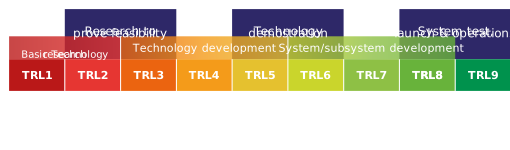
Technological Maturity 2
Strengths
- Cost
- Social/economic relevance
- Legal/regulatory content
Admissible applications
- Possible basis for machine learning of EO big data.
- Realistic patterns of olive-fly dynamics at fine spatial and temporal resolution.
- See https://doi.org/10.5281/zenodo.11374208
- Strategic analysis of crop management.
Research group involved
Patent Available for Licensing
Non disponibile per una licenza
Revision date
04-06-2025
Didn't find what you were looking for or would like more information ?