
Collection of ENEA technology and expertise

Biotechnologies to implement the exploitation of the symbiotic bacterium Wolbachia to control emerging mosquito-borne diseases
ENEA has developed a method to control the Asian tiger mosquitoes that is based on the exploitation of Wolbachia, a harmless bacterial symbiont of insects that harnesses host reproductive biology and increase their resistance to certain viruses favoring its own survival and spread. These properties can be exploited to estrablish laboratory populations of a target species that can naturally produce sterile males or females with reduced vector competence.

Application sectors
Problem to solve
Global Change is favoring the spread toward higher latitudes of a number of tropical pathogens that are transmitted by mosquitoes like the dengue, chikungunya, Zika and West Nile fever viruses. Current control methods are proving unsufficient at facing this burden mainly because mosquito vectors are developing resistance to most of the bioactive molecules exploited by the insecticides. Local epidemics of dengue and chikungunya have been already recorded in our country and the increase in the mean temperature during the winter season could lead to a significant increase of the risk because mosquitoes could reproduce and bite for longer. The WHO is launching a series of initiatives to tackle the burden of mosquito-borne diseases based on measures articulated in the Global Vector Control Response (GVCR) 2017–2030 and in the Global Arbovirus Initia-tive (GLAI), with the aim to build an integrated strategic plan to tackle emerging and re-emerging arboviruses with epidemic potential.
Description
An innovative biotechnology by ENEA can be deployed to control mosquitoes thanks to the exploitation of common and harmless bacteria, Wolbachia pipientis. These bacteria are strictly associated, as beneficial endosymbionts, to insect gonads. Crosses between mosquito males that are infected by Wolbachia and females that are either uninfected or infected by another incompatible strain of the same bacterium are fully unfertile. This natural phenomenon has be replicated in the laboratory in the Asian tiger mosquito, Aedes albopictus, by replacing the natural Wolbachia infection with a strain caught from another common mosquito species. The obtained males are capable to sterilize any wild female of the species without any further treatment. ENEA has developed specific protocols for the mass production and sexing of this laboratory population and has already successfully experimented this control strategy in Rome (Italy). These open field trials have been authorized by the Italian Ministry of Health and by the European Chemical Agency due to the demonstrated safety of this biocidal approach. Exploiting another strain of Wolbachia, ENEA has also established a further laboratory population characterized by females that are uncapable at transmitting the viruses that are responsible for dengue, chikungunya and Zika diseases. This population could be exploited to replace the wild Ae. albopictus population with an equal population that is uncapable at supporting epidemics. This strategy is already largely applied in the Tropics to successfully reduce the capacity by Aedes aegypti (a mosquito species that is closely related to Ae. albopictus) to support dengue, chykungunya and Zika epidemics.
Innovative aspects and advantages
- Eco-compatibility: the technology is environmentally safe because it is not associated with the introduction in nature of any chemical substance, noxious molecule, or any transgene.
- Effectiveness: the technology has been already demonstrated effective for: 1) the reduction of the fertility of targeted mosquito population (leading to a reduction of their capability to reproduce); 2) the biting rate; 3) the epidemiological risk.
- Industrializable: The technology can be scaled up through the construction of specific facilities where production protocols can be authomatized allowing for large-scale and long-term programs of deployment and leading to a cost reduction.
- Safety: the technology is absolutely safe for human health and for non-target organisms because it is based on the exploitation of natural mechanisms of control that are mediated by quite common bacteria that are not pathogenetic
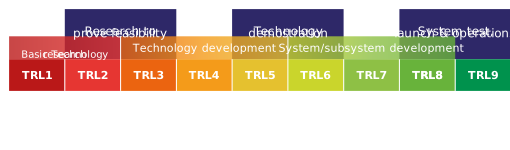
Technological Maturity 7
Strengths
- Cost
- Social/economic relevance
- Legal/regulatory content
- Efficiency/productivity/performance
- Innovation
- Lack of technology/solution for the specific task
- Scalability
- Ease of use
Admissible applications
- Mosquito suppression through the release of males that inseminate wild females with unfertile sperms making them incapable of reproduction. This will limit the possibility by the vector population to increase in size
- Replacement of mosquito populations that are competent vectors of viruses with populations that are unsuitable at transmitting viruses.
Research group involved
Patent Available for Licensing
Disponibile per una licenza esclusiva
Revision date
03-06-2025
Didn't find what you were looking for or would like more information ?