
Collection of ENEA technology and expertise

"Bio-Based products: Fico d'Ondia mucilage for construction and conservation and restoration of cultural heritage"
Prickly pear mucilage is used as an additive in mortars, plasters, and cement, increasing their plasticity, durability, and mechanical strength. Furthermore, compared to synthetic additives, it has greater affinity and compatibility with the substrate and is effective in inhibiting and/or delaying biological attack on buildings and artistic artifacts. The possibility of using natural extracts obtained from pruning waste represents a circular economy process based on the use of organic waste.

book Innovar desde la tradiction
Application sectors
Problem to solve
The use of natural substances in the construction and restoration sectors stems from the need and duty to explore environmentally, economically, and culturally sustainable alternatives. Prickly pear mucilage is a plant product extracted from the plant's leaves. In Italy, prickly pears are grown exclusively for the sale of their fruit, while the leaves represent the annual pruning waste, amounting to nearly 10 t/ha. In Mexico, it has always been used in construction, dating back to pre-Hispanic times. Studies over the past 30 years demonstrate promising results in the use of mucilage as an additive in the production of mortars, plasters, and cement, replacing synthetic additives. The resulting mixture dries more slowly and becomes more plastic, preventing cracks and crazing.
Description
Prickly pear mucilage is used as an additive in mortars, plasters, and cement, increasing their plasticity, durability, and mechanical strength, as demonstrated in the laboratory and in real-world cases. Furthermore, compared to synthetic additives, it has demonstrated greater affinity and compatibility with the substrate and is effective in inhibiting and/or delaying biological attack on buildings and artistic artifacts. The possibility of using natural extracts obtained through environmentally friendly methods already offers the advantage of limiting and/or replacing the use of synthetic chemicals, which are sometimes toxic to both the operator and the environment. This contributes to saving resources, water, and energy used in their production, and helps reduce emissions and hazardous waste. The product is obtained from pruning waste and therefore represents an opportunity to reuse plant parts that would normally be disposed of. This initiates a circular economy process based on the use of organic waste, prickly pear peels, which become a resource for other productive activities, with a view to closing cycles and implementing industrial symbiosis actions.
Innovative aspects and advantages
- circular economy
- natural biocide
- replace synthetic additives
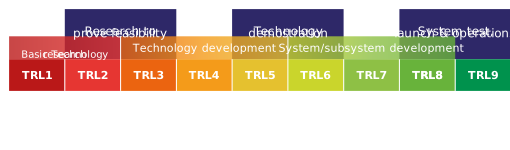
Technological Maturity 7-8
Strengths
- Cost
- Social/economic relevance
- Legal/regulatory content
- Efficiency/productivity/performance
- Innovation
Admissible applications
- Additive for lime-based materials
- Conservation and restoration of cultural heritage
Research group involved
Revision date
20-05-2026
Didn't find what you were looking for or would like more information ?