
Collection of ENEA technology and expertise

Bidirectional heat-exchange substation for thermal prosumer integration in District Heating Networks
The prototype bidirectional thermal exchange substation represents a technology capable of integrating thermal prosumers into district heating networks. The device is designed to optimize the utilization of locally generated heat, e.g. from renewable sources or waste heat recovery, prioritizing the coverage of user demand. In the absence or insufficiency of local production, the network operates as a conventional heat source. Conversely, when energy exceeds demand, the substation can feed the surplus back into the network.

Substation prototype: front view
Application sectors
Problem to solve
District heating represents a strategic technology for achieving energy-efficiency, sustainability, and renewable-energy targets. Next-generation networks are progressively shifting toward lower operating temperatures compared to traditional systems, thereby increasing the potential for integrating additional energy sources. The ability to distribute excess energy produced from variable renewable sources or recovered as waste heat enables a reduction in overall primary energy demand. Moreover, building retrofit interventions not only significantly reduce energy needs but also allow for lower operating temperatures of heating systems.
Description
The prototype bidirectional heat-exchange substation for district heating is a modular system capable of exchanging heat both with the district heating network (conventional heat exchange) and with a distributed generation system, consisting— for example—of renewable energy installations, high-efficiency combined heat and power units, or waste heat recovery. The substation enables the locally generated energy to be used as a priority to meet the user's thermal demand, to inject any surplus into the district heating network when production exceeds consumption, and to draw heat from the network in the absence of local generation. In this way, the user can operate as a thermal prosumer, acting simultaneously as both a consumer and a supplier of thermal energy. The prototype is equipped with multiple sensors for monitoring and recording energy flows, as well as actuators for controlling operational parameters and ensuring compliance with setpoints. The monitoring system acquires and logs all sensor signals (temperature, flow rate, pressure) and the states of controllable components. The control logic is primarily based on the regulation of temperatures and flow rates within the various substation circuits, using motorized valves and the circulation pump. Several experimental campaigns were conducted to verify the correct operation of the substation and to characterize its performance under steady-state and dynamic conditions, as well as under realistic user load and local generation profiles. Tests were performed with both standard and low-temperature network operation (through hardware-in-the-loop configurations and representative-day experiments). Strategies to increase the share of locally self-consumed renewable energy were also developed and validated, and a new substation configuration aimed at converting users of existing networks into thermal prosumers was experimentally demonstrated.
Innovative aspects and advantages
- 1. Support for efficient district heating: this technology enables the integration of increasing shares of heat from renewable sources or waste heat, reducing dependence on conventional energy sources.
- 2. Energy efficiency: by lowering the network's operational temperatures and integrating prosumers, overall efficiency is increased and fuel consumption is reduced.
- 3. Reduced losses and costs: lower heat losses along the network, use of less expensive materials and components, and decreased maintenance requirements.
- 4. Flexibility and retrofit potential: it can also be applied to existing networks, converting passive users into prosumers without requiring major structural modifications.
- 5. Integration into hybrid systems: connection to district heating networks enables the implementation of an optimized power-to-heat control strategy for heat-pump–photovoltaic systems.
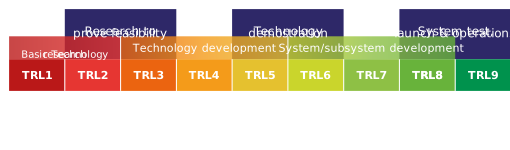
Technological Maturity 4-5
Strengths
- Cost
- Social/economic relevance
- Legal/regulatory content
- Efficiency/productivity/performance
Admissible applications
- 1. Integration of renewable sources and waste heat: enables the injection into the district heating network of locally produced thermal energy from variable renewable sources or waste-heat recovery, thereby contributing to system decarbonization.
- 2. Application in new networks or retrofit of existing systems: the technology can be deployed both in newly built district heating networks and as part of retrofit interventions on existing infrastructures.
- 3. Optimization of local self-consumption: the prioritization between local heat production, user demand, and heat exchange with the network can be managed, increasing self-consumption and reducing primary energy demand.
- 4. Support for energy planning and scenario analysis: through the associated numerical models, it enables predictive analyses, providing decision-making support to network operators and facilitating the development of thermal energy communities.
- 5. Application of the technology to hybrid solutions aimed at enhancing the sharing of renewable electricity by leveraging the thermal vector (see the S.A.P.I.EN.T.E. experimental system, record 8593).
Research group involved
Revision date
22-05-2026
Didn't find what you were looking for or would like more information ?