
Collection of ENEA technology and expertise

Antimicrobial surface coatings against bacteria, fungi and viruses
This technology consists in the development of antimicrobial surface coatings, produced by means of physical techniques and based on nanostructured inorganic materials, with high efficiency and wide spectrum against bacteria (even those resistant to conventional antibiotics), fungi and viruses. These surface treatments therefore can prevent the spread of infections and diseases deriving from the contamination of objects and surfaces in general, for use in multiple application fields: biomedical-healthcare, food safety, objects, clothing, aerospace, transport.

Application sectors
Problem to solve
Transmission of infections and diseases connected with the action of pathogenic agents (bacteria, fungi, viruses) is a crucial aspect for public health and it is the cause of millions of deaths every year in the world. This phenomenon is made even more critical by the growing resistance to conventional antibiotics, which is developed by numerous bacterial species. One of the most common paths for the spread of these microorganisms is their transmission from contaminated surfaces to others, until they reach the human body. It is therefore essential to develop surface treatments capable of effectively counteracting this phenomenon in the numerous areas where it occurs (biomedical-healthcare, food, textile, transport, public and private environments, etc.).
Description
This technology allows conferring the treated surfaces with efficient antimicrobial activity through the application of appropriate nanometric coatings (thin films, nanoparticles, nanostructured films) based on inorganic materials. By the combination of different elements, it is possible to increase the antimicrobial efficacy (even higher than 99%) and widen the spectrum of action against different types of pathogenic microorganisms at the same time (Gram-positive and Gram-negative bacteria sensitive and multi-resistant to antibiotics, fungi-yeasts, viruses). It is also possible to modify other properties of the treated surfaces, simultaneously with the addition of the antimicrobial functionality, such as aesthetic-optical characteristics, wettability, permeability, etc. The developed technology involves a multidisciplinary approach that includes the application of coatings on the surfaces through physical techniques, their chemical-physical characterization for the assessment of the functional properties, and the conduction of microbiological tests to evaluate the efficiency against different microbial species and analyses to verify that the coatings themselves are not toxic to humans. The versatility of processes and materials used permits the application of antimicrobial coatings on a wide variety of components and surfaces (metals, glass, plastics-bioplastics, etc.), thus promoting their use in multiple application fields: biomedical-healthcare, food, objects, textiles, clothing, public and private transport, aerospace, etc. The method used is sustainable because it allows obtaining high efficiency with the use of low amount of antimicrobial materials, non-toxic to humans, biocompatible and with low environmental impact, through the use of processes widely used in the industrial-commercial sector.
Innovative aspects and advantages
- Multidisciplinary team
- Possibility to customize solutions, materials and processes depending on the specific technical needs
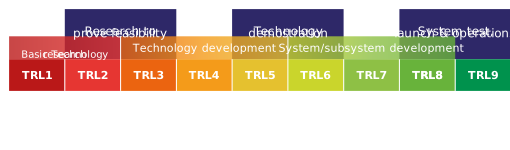
Technological Maturity 4
Strengths
- Cost
- Social/economic relevance
- Legal/regulatory content
Admissible applications
- Biomedical devices and tools (surgical instruments, cannulas, implants, prostheses, etc.)
- Components and objects frequently touched for personal use or in public places (smartphones, touch screens, handles, cards, personal or technical clothing, components in public environments and in private or public means of transport, etc.)
- Components for Aerospace (components and objects for vehicles and space stations, aerospace suits, etc.)
- Components for air or water filtration systems (face masks, air conditioning filters, water treatment, etc.)
- Food & Beverage (packaging and containers for food and drinks)
Research group involved
Revision date
30-01-2026
Didn't find what you were looking for or would like more information ?